
Buddha Circuit Connecting Major Faith Based Tourism Destinations of Kavrepalanchok
The major historical, religious, and tourist sites of the southeastern region of Kavrepalanchok are set to be developed into a trekking route known as the “Buddha Circuit.”
According to Kavrepalanchok MP Madhu Chaulagain, the federal government has allocated a budget of NPR 250 million for the circuit, which will connect the historic town of Panauti, Namo Buddha, and Timal. The project will be completed gradually through successive budgets.
In the first phase, NPR 100 million will be spent to develop the road from Panauti’s Dabali to Namo Buddha. Alongside the road, physical and cultural heritage related to Buddha will be constructed, including the installation of prayer wheels, chaityas, statues of Laughing Buddha, and informative boards such as thangkas.
He explained that existing roads will be transformed into the “Buddha Circuit,” and the master plan has already been prepared. The aim is to enrich the eight-kilometer stretch between Panauti and Namo Buddha with Buddhist heritage, turning it into an attractive tourist route.
Under the Buddha Circuit, a deer park will be built in the Bokse Community Forest of Dapcha, located along the Namo Buddha–Bhakunde road section.
The plan has already been submitted to the Bagmati Province’s Ministry of Forests for approval. “The site for the deer park has been selected, and the provincial government is supportive,” Chaulagain said.
Similarly, a “Cultural Confluence Gate” will be constructed at Chardobato in Bhakundebesi along the BP Highway. Visible from all directions, the gate will feature symbols and figures representing various religions and cultures.
Additionally, Buddhist heritage sites will be developed along the 25-kilometer stretch from Namo Buddha to Bhakundebesi and Timal, with prayer wheels, chaityas, Laughing Buddha statues, and thangka information boards installed.
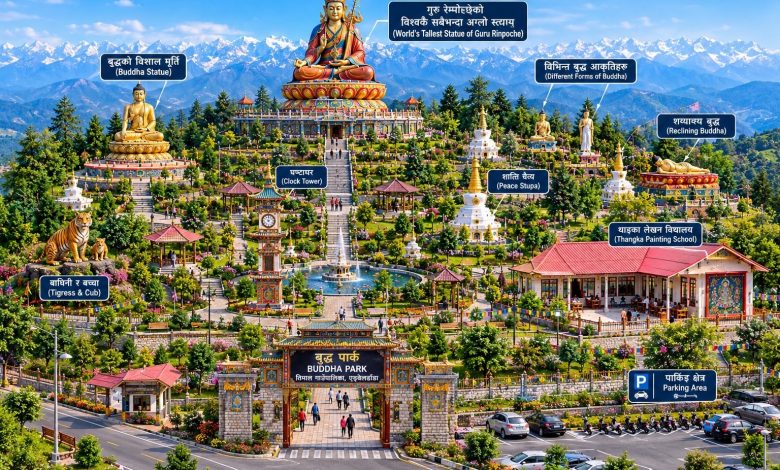
At Yangbel in Timal, a grand statue of Guru Rinpoche is planned. Land acquisition for the site has already begun. A “Buddha Park” will be built there, featuring the world’s largest statue of Guru Rinpoche, a massive Buddha statue, various Buddhist figures, a clock tower, a statue of a tiger with cubs, a peace chaitya, a Thangka painting school, and parking facilities.
Chaulagain noted, “Once the Thangka school is operational in Timal, people won’t need to travel to the city. They can learn here and also teach others. Through thangka, Timal will be introduced to both domestic and international audiences.”
Historians note that King Pratap Malla, after constructing Rani Pokhari in 1727 BS, included water from various pilgrimage sites, including Trivenighat in Panauti, as recorded in inscriptions.
Trivenighat is the confluence of three rivers, Punyamata, Roshi, and the sacred Padmavati, believed to flow invisibly. Just as the Saraswati River is believed to join the Ganga and Yamuna at Prayag in India, Roshi is considered Rudravati, Punyamata as Lilavati, and the hidden river beneath the Brahmayani temple as Padmavati in Panauti.
Namo Buddha is a historic, religious, scenic, and touristic site in Kavrepalanchok, known as the place where Gautam Buddha sacrificed his life after being reborn in Lumbini. Legend says that the youngest prince of King Maharath and Queen Satyavati of Panchaladesh (Panauti state) offered his flesh and blood to a starving tigress and her cubs while hunting in Gandhaman forest, giving his life to save them.
The Namo Buddha area features Lama and Mahayana monasteries, large stone Buddha statues, and chaityas. A popular saying goes, “If you want to explore Tamang history and civilization, go to Timal,” highlighting its cultural significance.
Historical accounts suggest that Guru Padmasambhava meditated in Timal and attained spiritual accomplishment during the reign of Rinjen Dorje Bal, before Nepal’s unification, while traveling from India to Tibet. Various structures and figures reflecting Timal’s history, civilization, and culture have also been built. (RSS)

Comments