
Compassion and Empathy Need of Today’s World, Says FM Khanal
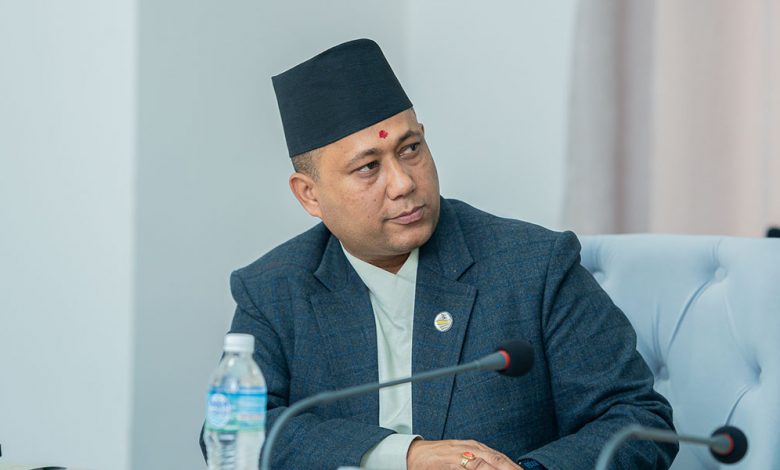
Minister for Foreign Affairs Shisir Khanal has said that today’s world requires Karuna—compassion—and empathy from everyone, especially those who hold great powers. “This compassion must extend not only to human beings but to all living and non-living beings alike—the marine life in our depths and the ecosystems on our peaks.”
In his statement to the 9th Indian Ocean Conference 2026 underway in Port Louis, Republic of Mauritius, he said we are bound not only by geography, but by shared responsibility. Nepal stands ready—as a partner in dialogue, a voice for the landlocked, and a bridge between the mountains and the ocean.
Speaking on the theme “Collective Stewardship for Indian Ocean Governance” at the second day of the three-day conference that began on Friday, he said for Nepal, collective stewardship begins with a simple recognition: the fate of the mountains and the ocean are inseparably linked.
Stating that climate change, maritime security threats, disruptions to global supply chains, and widening inequalities demand not just cooperation, but genuine collective stewardship, he said in the view of the Government of Nepal, stewardship means moving beyond narrow self-interest toward a shared responsibility for our global commons.
“This requires inclusive, transparent, and rules-based multilateral frameworks. These must be anchored in international law and guided by the principles of sovereign equality, mutual respect, and peaceful coexistence. Our governance must be equitable, ecological, and above all, inclusive of those who rely on the ocean from the landlocked interior.”
Standing that Nepal may be a landlocked nation, but our bonds with the Indian Ocean are ancient, organic, and inseparable, he said long before the age of modern diplomacy, Nepali traders, pilgrims, and scholars moved along routes that connected the high Himalayas to the shores of this great ocean.
“These routes were not just for trade; they were conduits for ideas. The philosophies and traditions that form our shared civilizational heritage moved along these currents. Most notably, these shores carried the teachings of Gautama Buddha, who was born in the sacred gardens of Lumbini, Nepal.”
Referring to the Buddhist principle of “Pratītyasamutpāda”, the law of dependent origination, which teaches us that nothing exists in isolation, Foreign Minister Khanal said this teaching reminds us that all phenomena arise in dependence upon other causes and conditions. The Indian Ocean and the Himalayas are not distant strangers; they are bound together by ecology, hydrology, and destiny.
The Hindu Kush Himalaya region, serves as the primary source of fresh water for billions of people. The glaciers and snowfields of Nepal feed the great river systems that ultimately discharge into the Indian Ocean. Therefore, the health of the mountains and the health of the ocean are inseparable, he added.
Meanwhile, referring to the global Context and Middle East, the Foreign Minister said we cannot ignore the conflicts unfolding in the Middle East. As millions of Nepali citizens live and work in the region, their safety remains our foremost concern.
The consequences extend far beyond the region—affecting fuel prices, supply chains, and livelihoods back home. These disruptions remind us that the stability of the Indian Ocean is inseparable from global peace.
As Nepal’s glaciers retreat at unprecedented rates, we face the imminent threat of glacial lake outburst floods that endanger entire communities. At the same time, the Indian Ocean is warming faster than any other ocean, driving sea-level rise that threatens the very existence of low-lying island states and coastal communities.
Stating that Nepal has been vocal about this nexus at the United Nations and COP summits, Minister Khanal called upon this Conference to formally recognize this ecological bridge as a critical dimension of Indian Ocean governance. Our stewardship must encompass both the peaks and the waters, for they rise and fall together.
As a signatory to the United Nations Convention on the Law of the Sea (UNCLOS), Nepal reaffirms its commitment to the foundational framework for the law of the sea. We emphasize that landlocked nations possess inherent rights to access the high seas and to participate in the maritime economy. These are not privileges granted by geography, but rights enshrined in international law.
The Indian Ocean is central to global trade and energy flows. Its stability is therefore a global responsibility.
Foreign Minister Khanal said Nepal is deeply concerned by threats such as maritime terrorism, piracy, and illicit trafficking of drugs and human beings. These challenges affect real lives, including those of Nepali citizens who travel across these waters in pursuit of livelihoods.
“We support the peaceful resolution of disputes through dialogue and international law. Nepal’s foreign policy is grounded firmly in the UN Charter, the principles of Panchasheel, and non-alignment. We call for a rules-based international order where the rights of all nations, large and small, are respected.” (RSS)



Comments