
NRNA at Crossroads
Sabika Shrestha
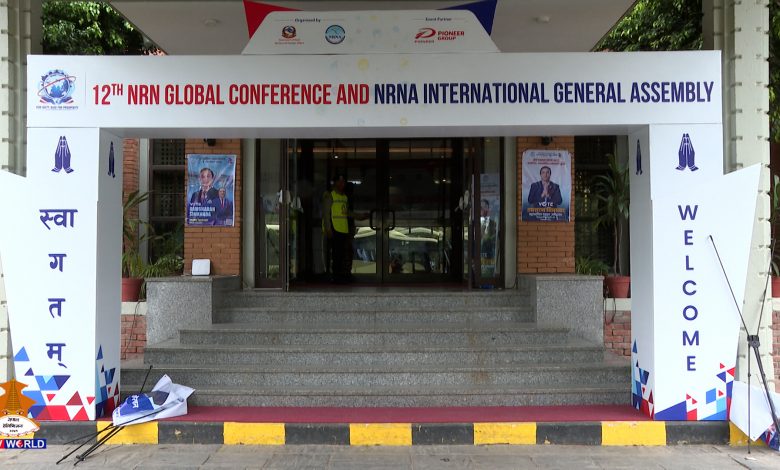
The Non-Resident Nepali Association (NRNA) is holding its 12th World Conference and International General Convention in Kathmandu, an event widely viewed as a convention aimed at restoring unity within the organization.
The gathering is set to elect a new leadership of the International Coordination Council (ICC) for the next two-year term.
The convention comes at a time when concerns have grown over divisions and politicization within the diaspora body.
The NRNA was conceptualized to stand as a robust link between Nepali Diaspora and the motherland.
However, the institution remains marred by gradual disintegration under political guise.
With growing dissent and disintegration, attention has turned to how the new leadership can shy away from subtle politicization of the movement.
The leadership race has drawn interest among non-resident Nepalis worldwide, with candidates including Robin Prasad Sherchan and Dr. Hemraj Sharma competing for the presidency.
Efforts have been underway until the 11th minute to forge an agreement and elect a new leadership unanimously.
Dr. Hemraj Sharma, Vice President of NRNA, says around 8 million Nepalis are living abroad, yet the organization has only about 100,000 members, which is roughly two percent of the diaspora population. “This shows that the vast majority of NRNs are still not connected with the organization,” he says.
Sharma adds that NRNA has made significant commitments to the nation and the government also holds high expectations from the diaspora. “We need to be clear about what we can realistically deliver,” he says. According to him, instead of only seeking wealthy investors, the focus should be on connecting Nepalis across the world. “Even small investments from many people can accumulate into a large amount of resources that can contribute to Nepal’s development,” Sharma says.
Sharma emphasized that NRNA should work to introduce second-generation Nepalis to their roots and culture while serving as a bridge between the diaspora and Nepal.
The organization since its inception in 2003 has served as a link between Nepal and millions of Nepalis living abroad.
Stakeholders say the incoming leadership will play a crucial role in mobilizing diaspora resources, encouraging investment, and promoting knowledge transfer that can assist Nepal’s economic and social development.
NRNA activists however say that political groupism and differing mindsets sometimes affect the organization but noted that politics can be practiced constructively if guided by the right intent
Prasuna Khanal, Europe Women Regional Coordinator of NRNA says political influence is visible in the association, both directly and indirectly, with pressure also evident in the current situation. She says individuals often carry personal beliefs or political mindsets shaped by their backgrounds. According to her, politics exists everywhere from homes and communities to the nation and even NRNA but it should be practiced in the right way, without bringing political interference into the association.
NRN citizenship might have been a win for the movement after marathon engagement with multiple governments since the promulgation of the new constitution, but various issues including the 7-year criteria and procedural hurdles have made it difficult to obtain.
One of the major agendas of voting rights for NRNs remains in every political party’s manifesto but so far has been unmaterialized.
Experts note that a strong and unified leadership could help channel the expertise and capital of non-resident Nepalis into sectors such as tourism, entrepreneurship, technology, and infrastructure, areas seen as vital for the country’s growth.
Unanimous election of new leadership shows prospect of making the politically disintegrated movement again unified as other agendas remain overshadowed as long as the power groups within the movement act under political guise.

Comments