
Airspace Disruptions Affect Nepal Travel
Sabika Shrestha
Escalating tensions in the Middle East have severely disrupted international flights through one of the key transit hubs in the world.
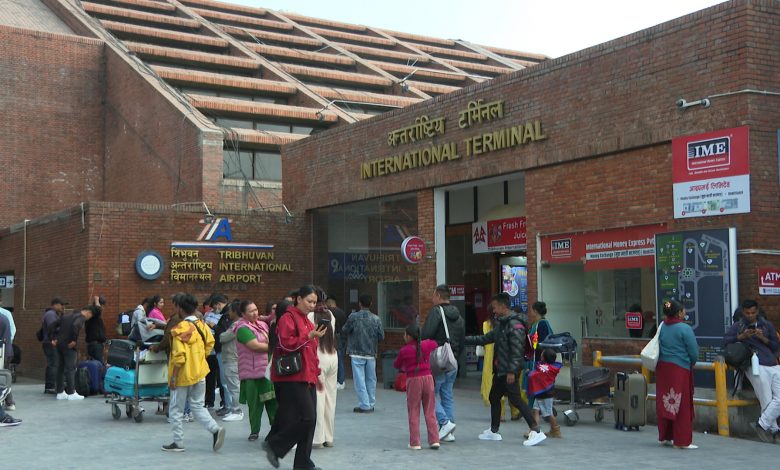
This has left many travelers struggling to reach their destinations including those from Tribhuvan International Airport in Kathmandu.
A Passenger said, “The problem is that flights have been cancelled; everyone has come for either rescheduling or a refund. I feel it would be easier if people could be rescheduled to reach their destinations as quickly as possible. Currently, rescheduling cannot be done online, so people have to come here and stay in line all day. It would be much easier for everyone if this could be done online.”
This is a regular routine for many Nepali migrant workers who are knocking the doors of their flight operators to reschedule their ticket.
Disruption of flights in some of the major labor destinations of Nepali migrant workers has troubled thousands who had come home on vacation.
They are more worried about reaching their destination rather than personal safety despite the conflict in the Middle East escalating by the day.
Since the workers travel on a tight schedule and fear losing their job contract if they don’t reach within 60 days, they are hit the panic button.
Another major issue is that many travelers have come to Nepal on short leave, usually for only one or two months,” Travel agent Bishnu Karki said. “In many cases, companies provide a maximum of 60 days of leave. If workers fail to return within that period, their visas automatically expire, even if they were technically still valid, which can ultimately lead to the loss of their employment,” he said.
“Most Nepali passengers traveling to destinations in the Middle East, Europe, and the United States have traditionally relied on Middle Eastern airlines because they offer more affordable fares. However, with these airlines currently shut down, the movement of Nepali travelers has effectively come to a halt,” he added.
The disruption, which began on March 12 has impacted flights through major transit hubs such as Doha, Dubai, Abu Dhabi, Kuwait, and Jordan also affecting passengers transiting in those destinations.

As a result, hundreds of passengers have been left stranded or forced to delay their travel, creating congestion at airline counters at Tribhuvan International Airport (TIA) and their head offices.
Airlines operating from Nepal and the Middle East have reduced or cancelled a number of flights as the regional airspace remains partially restricted.
Aviation officials say more than 75 flights have been cancelled over the past two weeks, leaving more than 12,000 passengers affected.
Meanwhile, officials at Tribhuvan International Airport say airlines are gradually adjusting operations to minimize disruptions.
Santusta Kumar Basnet, Spokesperson of Tribhuvan International Airport said, “Flights are not currently operating on a full schedule. At the moment, our main priority is assisting the many stranded passengers. We are in close coordination with the airlines, and they are issuing regular notices about which flights are operating and which have been cancelled. These daily public updates are helping passengers stay informed and manage their travel plans accordingly,” he added.
As of Thursday evening, only three rescue flights, one each from Nepal Airlines, Himalaya Airlines and Air Arabia have landed at Tribhuvan International Airport ferrying stranded passengers at Dubai airport.
According to the TIA, two flights, one of Fly Dubai and another of Air Arabia, have been scheduled to depart to Dubai on Thursday.
Authorities say they are closely monitoring developments in the Middle East and coordinating with airlines to ensure passengers are assisted as the air space over major labor destination of Nepali migrant workers struggles to operate.



Comments