
Nepal Pushes Mountain Climate Risks onto Global Agenda at COP31
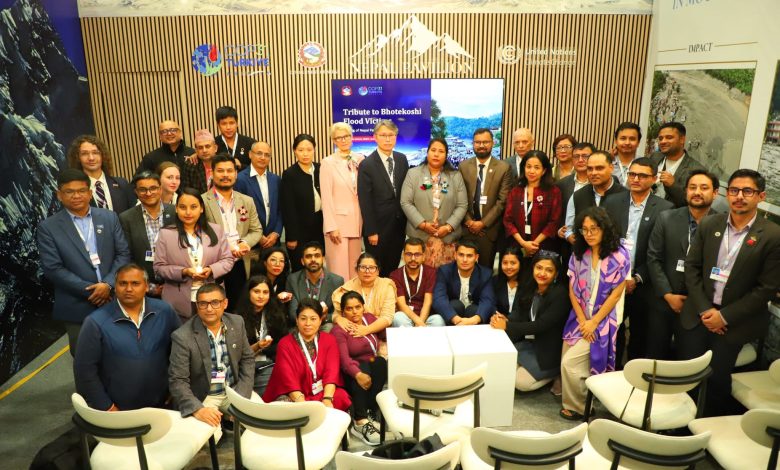
Nepal has made a special push at the 31st UN Climate Change Conference (COP31) to bring the concerns of climate-vulnerable mountain regions to the centre of international climate negotiations.
The country has prioritised mountain climate risks, the devastation caused by the Bhotekoshi floods, climate justice and adaptation measures during the conference in Antalya, Türkiye.
Speaking at the closing ceremony of the Nepal Pavilion on Thursday, Minister for Agriculture, Forests and Environment Geeta Chaudhary said Nepal’s mountain agenda was not merely a national concern but a shared global issue linked to the wider climate crisis.
“Nepal came to Antalya with a clear agenda on mountains. This pavilion has become a common platform to share our concerns, challenges and priorities,” the Ministry quoted her as saying.
Chaudhary said she had participated in the COP process not only as a minister but also as a representative of millions of Nepalis seeking to bring mountain-related concerns into international climate discussions.
She added that taking the voices of people affected by the Rasuwa-Bhotekoshi floods to the international community was also part of her responsibility.
The minister paid tribute to all Nepali and foreign nationals who lost their lives in the Bhotekoshi floods and expressed condolences to their families, relatives and respective countries on behalf of the Government and people of Nepal.
She said the deaths of foreign nationals who had come to Nepal as tourists, workers, experts, engineers, investors and infrastructure development partners represented a shared loss for both Nepal and their home countries.
“We will honour their memory by learning from this tragedy and working to prevent such disasters in the future,” she said.
Describing the Bhotekoshi floods as a warning not only for Nepal but also for the international community, Chaudhary said climate change was a reality that Nepali people were experiencing firsthand.
She noted that climate-related risks in mountain regions affect communities across wider geographical areas, from the high mountains to downstream and coastal regions.
NEPAL STEPS UP INTERNATIONAL ADVOCACY FOR MOUNTAIN ISSUES
During COP31, Chaudhary held bilateral discussions with ministers from various countries, heads of climate finance mechanisms, UN agencies and representatives of other international organisations to advance Nepal’s mountain agenda.
She also acknowledged the contributions of Nepali ministers, lawmakers, experts, journalists and other delegation members involved in the negotiations.
Noting that delegates had worked for extended hours to reach agreements on difficult issues, she said their patience, dedication and commitment had helped move the multilateral process forward.
The minister thanked the Government of Türkiye and the COP31 Presidency, development partners, international organisations, civil society groups, young people, the private sector and the team involved in managing the Nepal Pavilion.
She urged all delegates to return with a shared commitment to ensuring that no community has to face the climate crisis alone.
NEPAL PAVILION HOSTS 47 CLIMATE-RELATED EVENTS
The Nepal Pavilion organised 47 climate-related events between November 9 and 19 during COP31.
According to the available records, the events featured 288 speakers, including 171 men and 117 women.
Of the speakers, 133 were Nepali, while 155 were affiliated with foreign organisations. The discussions brought together Nepali experts and stakeholders, alongside international delegates, researchers and specialists from global organisations.
Established under the leadership of the Ministry of Environment, the pavilion hosted events organised by government agencies, national and international non-governmental organisations, research institutions and development partners.
Participating organisations included the Ministry of Environment, Ministry of Health and Population, National Trust for Nature Conservation, Department of Forests, Department of Hydrology and Meteorology, the International Centre for Integrated Mountain Development (ICIMOD), Asian Development Bank, United Nations Development Programme, World Health Organization and International Water Management Institute.
Other participating organisations included the Consultative Group on International Agricultural Research (CGIAR), Practical Action, Heifer International, Oxfam, Save the Children, CREASION, NGO Federation of Nepal and Nature Resources Centre, among others.
DISCUSSIONS RANGE FROM CLIMATE FINANCE TO FLOOD DISASTER
Discussions at the Nepal Pavilion covered a wide range of climate-related issues, including climate-resilient food systems, health, energy infrastructure, early warning systems, a just transition away from fossil fuels, zero waste, mountain conservation, green hydrogen, green fertiliser, carbon markets and climate finance.
Other sessions focused on climate-induced human mobility, disaster risk reduction in mountain regions, climate-resilient education, climate-related losses and damage faced by women, and both economic and non-economic losses and damage.




Comments