
Chapagain Appointed Global Ambassador for the Grand Bargain
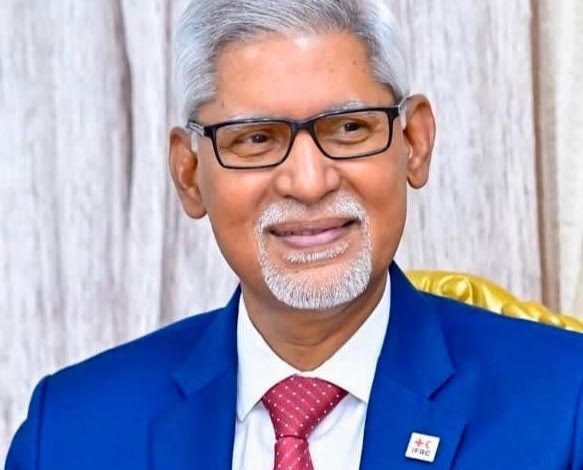
General of the International Federation of Red Cross and Red Crescent Societies (IFRC), Jagan Chapagain, has been appointed Global Ambassador for the Grand Bargain, a major global initiative aimed at making humanitarian action more effective, accountable, equitable and locally led. He was formally welcomed into the role at the 2026 Grand Bargain Annual Meeting in Geneva and will champion the agenda for an initial two-year term.
In this new role, Chapagain will work across governments, donors, United Nations agencies, international and national NGOs, the Red Cross and Red Crescent Movement, and local humanitarian organizations to build greater collective action around some of the most pressing challenges facing the humanitarian system.
The Global Ambassador role is distinct from his responsibilities as IFRC Secretary General. As Ambassador, he will act on behalf of the wider Grand Bargain community, bringing its different constituencies together around a common agenda. The Grand Bargain was launched following the 2016 World Humanitarian Summit as an ambitious effort to reform the way humanitarian assistance is financed, organized and delivered.
Ten years after its creation, the Grand Bargain is now entering a new phase. From January 2027, it will operate as the Collective Action Platform for the Grand Bargain, or CAP4GB. The evolved platform will focus particularly on three enabling areas: quality funding, localization and equitable partnerships, with accountability to affected people and gender equality retained as cross-cutting priorities.
The shift is intended to move the Grand Bargain increasingly from global commitments to practical implementation at country level, including through National Reference Groups and stronger links between country-level evidence and global humanitarian decision-making. As Global Ambassador, Chapagain is expected to provide the political leadership, visibility and convening power needed to advance this agenda at the highest levels of the humanitarian system. His initial mandate is for two years, with the possibility of renewal.
A central part of his role will be to champion the perspectives of local and national humanitarian actors and ensure that evidence and experience from countries reach senior global decision-makers. He will work impartially across the Grand Bargain’s different constituencies and in close cooperation with its Facilitation Group and Secretariat.
Chapagain has outlined three straightforward commitments for how he intends to approach the role: listen first; carry what he hears to those with the power to address the problems; and follow up on commitments to ensure that they are actually delivered. He has also made clear that his aim is not to create another strategy, but to help turn existing commitments into action. Local leadership will be a particular priority.
Chapagain has committed to using his global engagements to bring the voices and experiences of people and organizations working closest to crises into international humanitarian discussions and decisions.
“Ultimately, the success of this platform will not be measured by the commitments we make in meeting rooms, but by whether people see and feel a difference in their daily lives,” Chapagain said after taking on the new role. Chapagain, a Nepali national, has served as Secretary General of IFRC since February 2020.
His appointment as Global Ambassador places him at the centre of a renewed international effort to ensure that humanitarian reform translates into greater local leadership, better-quality financing, more equitable partnerships and, ultimately, better outcomes for people affected by crises. (RSS)



Comments