
Communications Minister Stresses on Promotion of Factual and Responsible Journalism
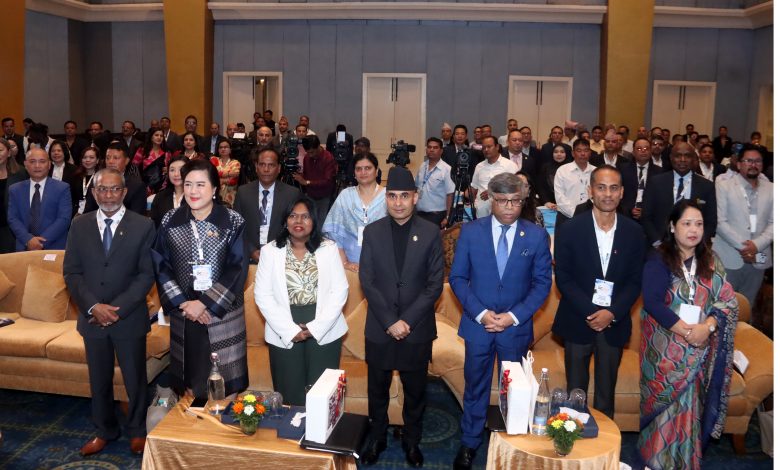
Minister for Information and Communications Dr Bikram Timilsina has said the right to freedom of expression, press freedom, citizens’ right to information and public interests should be at the centre as the communications sector undergoes transformation amid the rapid development of Information Technology (IT).
Addressing the 24th Conference of Asia Pacific Institute for Broadcasting Development (AIBD) jointly organized by the Public Service Broadcasting Nepal and the Association of Community Radio Broadcasters (ACORAB) here today, the Minister emphasized the need to promote fact-based, credible journalism through the integration of artificial intelligence, digital platforms and new technologies.
Despite significant transformations in information technology, he reiterated that basic norms, values and principles concerning the right to information, to expression and freedom of the press must be protected.
Along with freedom of the press, the media have a primary responsibility for providing fact-based, credible, impartial, balanced and accountable news content to the citizens.
He was of the opinion that solutions to misinformation or propaganda should not be sought through bans or restrictive measures, while stressing on the need to give top priority to the strengthening of robust journalism.
He was of the opinion that the role of the media is more vital during crises and naturadisasters for covering issues of public concern, including public health.
Since AI, misinformation and propaganda can transcend borders, and the impacts of climate change and natural disasters are multinational, different countries should benefit from exchanging knowledge, technology and experiences with another to deal with such challenges effectively.
He added that AI, digital platforms, mobile connectivity and streaming services are changing the entire media chain from content production to distribution and interaction with the audience. He was of the opinion that such changes should be viewed not only as a challenge but also as a great opportunity for media transformation.
Stating that new opportunities have been created to connect with the younger generation through digital platforms, he said that information, news, education and awareness-raising materials of public interest should be effectively delivered through the platforms used by young people.
Communications Minister Dr. Timilsina said that modern technology cannot replace human editorial decisions, fact-checking, accountability, and professional ethics.
He clarified that while AI can help in creating content, the ultimate responsibility for its accuracy, context, social impact, and public interest still lies with humans.
“Because artificially created content and ‘deepfake’ technology can make false information look real, the most important asset for the media right now is the trust of the citizens,” he said, adding that the media organizations that can advance both technological capabilities and journalistic credibility together will be the ones successful in the future.
Minister Timilsina said Nepal was the first country in South Asia to establish an independent community radio and the journey of community radio that started with Radio Sagarmatha has now spread across the country.
The Communications Minister said that community radio not only connects various communities in the mountains, hills, and Tarai but also gives a platform to the voices of citizens who could not come forward in public debates.
Stating that during times of disaster, crisis, and health emergencies, community radio has played an important role in providing immediate and reliable information in local languages, he clarified that in situations like earthquakes, floods, landslides, and pandemics, community radio has become an effective medium for delivering information, raising public awareness, and sharing rescue and relief-related updates.
The Communications Minister mentioned that digital transformation does not just mean using new technology, but also strengthening credibility, journalistic professionalism, fact-checking, public accountability, and citizens’ trust.
He said that with the increasing risk of misinformation and disinformation from misleading content, and such AI-generated material, public service broadcasting needs to establish itself as an institution that citizens can trust for accurate information.
During the conference opening, Communications Minister Dr Timilsina emphasized the need to connect Nepal’s public service broadcasting with the new generation, expressing that quality content should be produced for the digital platforms used by youth and that their voices, ideas, and creativity should be included in public broadcasting.
He stated that including citizens from rural and remote areas, marginalized communities, and those who speak different languages equally is an important responsibility of public service broadcasting.
Journalists, policymakers, and representatives of major broadcasting organizations from about 40 countries, including those from the Asia-Pacific region, Europe, and African countries, are participating in the conference. (RSS)


Comments