
Nepal Pushes Global Climate Action for Himalayas at Brussels Dialogue
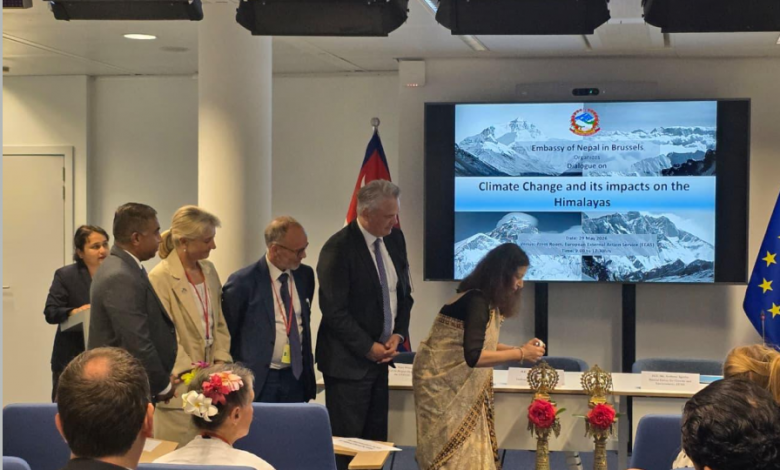
Nepal has called for stronger global climate cooperation and urgent action to protect the fragile Himalayan ecosystem during a high-level dialogue organized by the Embassy of Nepal in Brussels at the European External Action Service (EEAS).
Held on Friday to mark International Everest Day, commemorating the first successful human ascent of Mount Everest, the event focused on climate change and its growing impact on the Himalayan region.
According to the Embassy, the programme brought together ambassadors, diplomats, senior officials from Nepal, Belgium and the European Union, climate scientists, academics, international organizations and members of the Nepali diaspora.
A video message from Foreign Minister Shisir Khanal was played during the event, in which he stressed the shared global responsibility to safeguard mountain ecosystems severely affected by climate change. Extending greetings on International Sagarmatha Day, he reaffirmed Nepal’s leadership and commitment to climate advocacy.
Nepal’s Ambassador to the BENELUX countries and Head of Mission to the EU, Sewa Lamsal, highlighted the increasing climate vulnerabilities facing Nepal and stressed the need for greater international support.
She said implementing Nepal’s National Adaptation Plan requires significant financial resources and urged the international community to honour treaty commitments, act on scientific evidence and respect the International Court of Justice’s advisory opinion on climate justice.
Maheshwar Dhakal, Head of the Climate Change Management Division under Nepal’s Ministry of Agriculture, Forest and Environment, delivered a keynote address on climate financing for a resilient Nepal.
He said Nepal has adopted ambitious measures including community-based adaptation, renewable energy expansion, forest conservation and Nationally Determined Contributions (NDCs), but noted persistent structural flaws in global climate financing mechanisms, including high transaction costs and limited accessibility for vulnerable countries.
Anthony Agotha, Special Envoy for Climate and Environment at the EEAS, praised Nepal’s diplomatic efforts in raising climate concerns globally and reaffirmed the European Union’s commitment to supporting climate-vulnerable nations.
Similarly, Peter Wittoeck, Head of the Belgian Delegation to the UNFCCC, underlined the vulnerabilities of mountain ecosystems and highlighted Belgium’s continued international cooperation in addressing climate challenges faced by Least Developed Countries.
Camilla Bruckner, Director of United Nations Brussels, described the Himalayas as a critical global public good and emphasized the need for a system-wide and collaborative approach to climate action instead of isolated project-based interventions.
The programme also featured a video message from Dr. Pema Gyamtsho, Director General of International Centre for Integrated Mountain Development, who described the Hindu Kush Himalayan region as the “Third Pole” of the world, providing freshwater and ecosystem services to nearly two billion people across eight countries.
Dr. Prajal Pradhan, Associate Professor at the University of Groningen in the Netherlands, presented a science-based analysis highlighting the importance of balancing ecological limits with societal development to achieve sustainable climate action.
The event concluded with an interactive discussion among participants on collaborative approaches to addressing the interconnected climate challenges facing the Himalayan region.


Comments