
PM Shah links Himalayan climate warning to call for a fairer global order
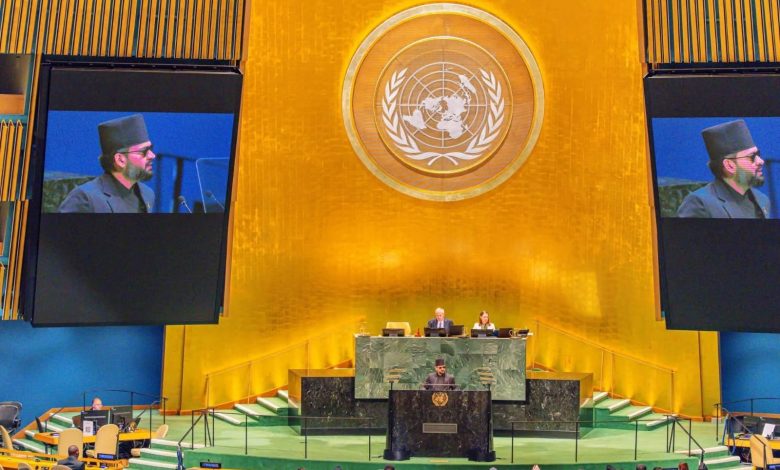
Prime Minister Balendra Shah has linked Nepal’s worsening climate risks with wider challenges facing the international system, calling for stronger multilateral cooperation, greater climate support and a global order that gives greater weight to the concerns of vulnerable countries.
Addressing the 81st session of the United Nations General Assembly, Prime Minister Shah recalled UN Secretary-General António Guterres’ warning from Nepal’s Everest region nearly three years ago that the “rooftops of the world are caving in.”
Guterres issued that warning during his visit to the Everest region in October 2023, when he said Nepal had lost close to one-third of its ice in just over three decades and that its glaciers had melted 65 percent faster in the previous decade than in the decade before it. He also warned that the Himalayan glaciers provide freshwater to more than one billion people.
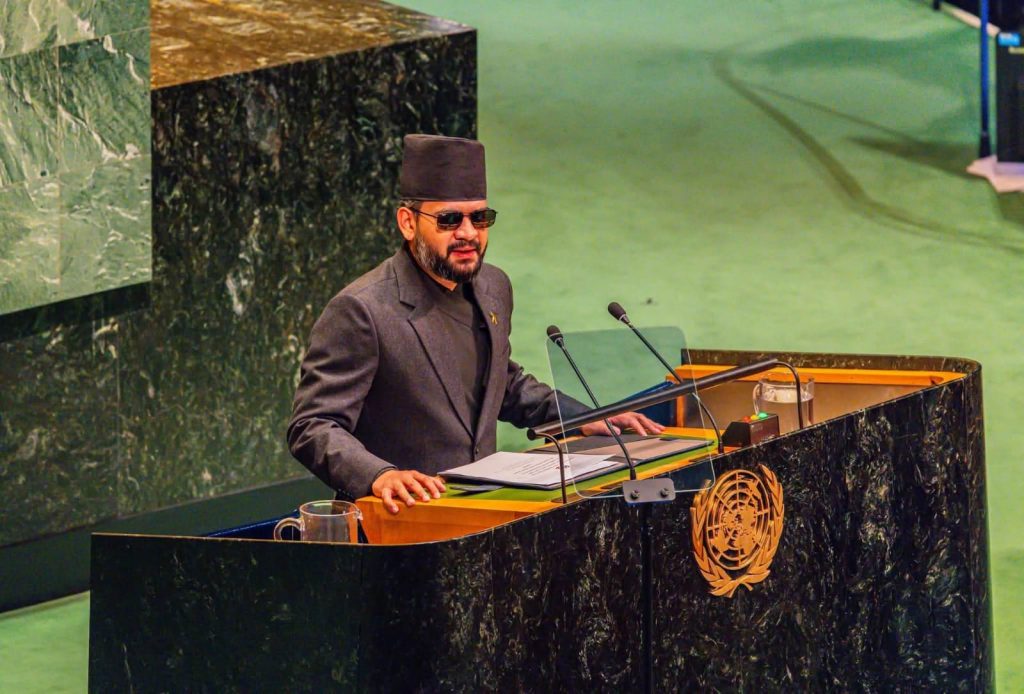
PM Shah said the warning had not translated into action at the speed and scale required by vulnerable communities. Referring to the recent Bhotekoshi-Trishuli disaster, he said the floods demonstrated that the consequences of climate change are already being felt on the ground.
He said Nepal contributes less than 0.1 percent of global greenhouse-gas emissions, while facing growing risks from retreating glaciers, unstable mountain slopes and increasingly unpredictable rivers. The disaster, he said, had also disrupted Nepal’s development by damaging infrastructure, homes, livelihoods and clean-energy facilities.
The Prime Minister reiterated that Nepal does not seek to turn climate change into a geopolitical dispute. Instead, he called for shared responsibility and solidarity, arguing that climate justice should include adequate grant-based support for countries facing climate-related losses.
The Prime Minister then broadened his address to the functioning of the international system.
He said the UN was founded on principles including sovereignty, international law, human dignity and the protection of weaker countries, but argued that the system is now under strain and that military and economic power can influence whose voices are heard.
Shah called for a fairer global economic order, linking international inequality with everyday challenges faced by people in Nepal.
He cited shortages of fertiliser, bitumen and cooking fuel and questioned the contrast between the speed with which military supplies cross international borders and the difficulties faced by farmers and households in accessing essential goods.
He also referred to countries across South Asia, including Bangladesh, Bhutan, India, the Maldives, Pakistan and Sri Lanka, saying they are confronting the combined effects of climate change and conflicts beyond their borders.
Shah said Nepal remains committed to multilateralism and called for a United Nations in which the voices of small and less-developed countries can be more effectively heard.
He defined climate justice not only in terms of financial support, but also in terms of who bears the costs of climate change, who participates in decision-making and whether vulnerable communities and future generations receive equal consideration.
The Prime Minister concluded by calling for a shift from ad-hoc disaster responses towards preparedness, including stronger infrastructure and institutions, investment in resilience and insurance, reduced fossil-fuel dependence, and systems capable of warning communities and saving lives.
UN Secretary- General Guterres has since reiterated that the climate crisis has moved from a distant warning to a daily reality. In his opening address to the 81st General Assembly, he also identified climate change alongside war, inequality and artificial intelligence as major tests facing the international system.

Comments