
At least 10,000 EV Charging Stations Needed across the Country
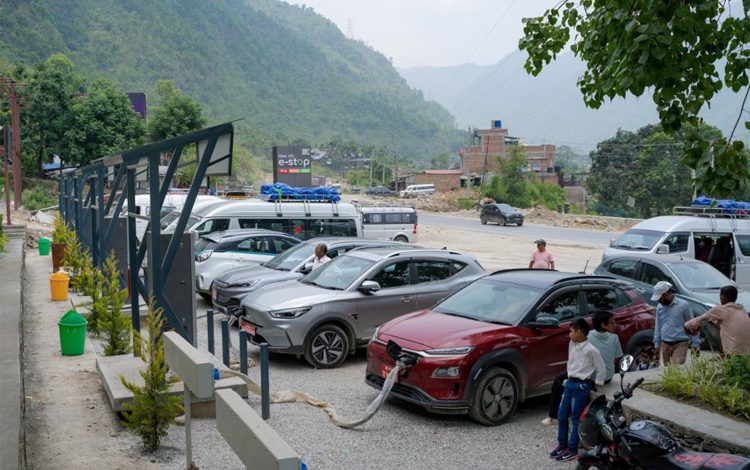
At least 10,000 charging stations need to be built across the country to further promote electric vehicles (EVs). A study report on ‘Opportunities, Challenges and Prospects for EV Promotion in Nepal’ conducted by the Ministry of Infrastructure Development has recommended setting up at least 10,000 charging stations by 2030.
Currently, a total of 1,000 charging stations are in operation across the country, with most of the stations being operated by official dealers of electric vehicles in the country.
Most of the stations are concentrated in major urban areas including Kathmandu, Pokhara, and Bharatpur.
The erstwhile Ministry of Physical Infrastructure and Transport had formed a task force to recommend measures to promote electric vehicles in the country. The task force was coordinated by Joint Secretary of the ministry, Krishnaraj Pantha. It has among others identified charging infrastructure, battery cost, road infrastructure, battery reuse and disposal as challenges.
Similarly, lack of skilled human resource, limited private sector participation, lack of skills development, and dependence on import of vehicle spare parts, high initial cost and low resale value, quality of vehicles, lack of qualified drivers, and inability to use electric vehicles as large vehicles and cargo vehicles have been identified as challenges.
Investment in electric transport-friendly physical infrastructure, private investment incentives, charging stations and battery swapping (modern and fast technology for charging electric vehicles) policies, challenges of battery life and management, research and development of technology, and lack of formulation of standards have also been considered as challenges.
According to the Report, insufficient charging facility on highways, rural areas and villages has caused problems in using electric vehicles as public transport and managing long-distance travel.
The government has adopted a policy to promote electric vehicles with the aim of increasing domestic consumption of hydropower. It has also set a goal to promote electric vehicles in the budget for the upcoming fiscal year.
Meanwhile, the Nepal Electricity Authority is operating 62 fast chargers with a capacity of 142 kilowatts.
The ‘Energy Consumption Growth and Export Strategy, 2083’ prepared by the Energy, Water Resources and Irrigation Ministry mentions expanding the network of charging stations across the country. The target is to complete this work by the fiscal year 2085/86.
The Ministry of Energy has designated the NEA as the responsible body for this task. The ministry also aims to develop domestic electricity consumption capacity by operating electric buses and trolley buses in major cities. (RSS)



Comments