
Nepal and WFP Showcase School Meals as Pathway to Sustainable Development
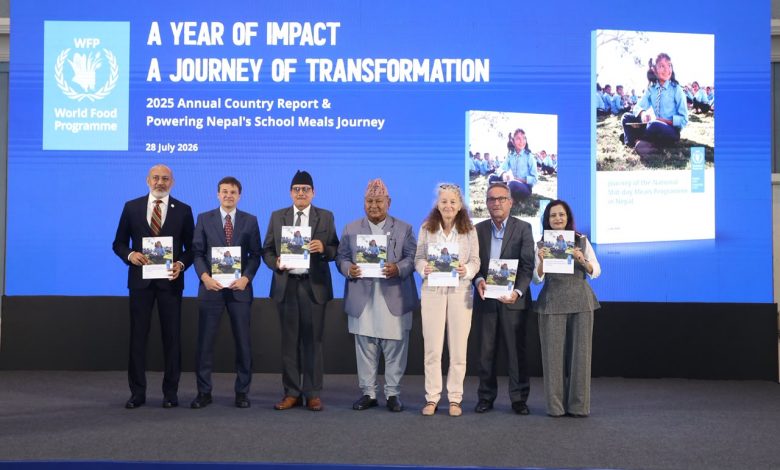
The Government of Nepal and the United Nations World Food Programme (WFP) today launched two reports that highlight the remarkable progress made in strengthening food security, nutrition, education, climate resilience and social protection through strong national leadership and partnerships.
The two publications – the Journey of the National Mid-Day Meals Programme and WFP’s Annual Country Report 2025- document Nepal’s development achievements and its transition from partner supported interventions to nationally owned systems that improve the lives of millions of people, according to a WFP press release.
Together, they demonstrate how sustained investments, partnerships and strong government leadership have contributed to building resilient institutions and advancing progress toward the Sustainable Development goals, the WFP stated.
“The achievements celebrated today reflect the power of partnership” noted Riaz Lodhi, WFP Representative and Country Director in Nepal. “Together with the Government of Nepal, development partners, and communities, WFP has helped advance solutions that strengthen food security, improve nutrition, build resilience and support human capital development.”
The Journey of the National Mid-Day Meals Programme in Nepal chronicles more than five decades of Nepal’s school meals programme. Beginning in 1967 as a small initiative to address classroom hunger, it has now evolved into one of the country’s largest social protection programmes, reaching nearly three million children across all 77 districts and becoming fully financed by the Government of Nepal in 2025.
The report highlights the programme’s contribution to improved school enrolment, attendance, retention and nutrition outcomes, while also strengthening local food systems through the Home-Grown School Feeding approach that connects schools with local smallholder farmers through cooperatives.
“Finland is proud to support Nepal’s education sector through the School Sector Education Plan and Home-Grown School Feeding programme,” said Petri Puhakka, Ambassador of Finland to Nepal. “School meals in Nepal are not just about feeding children: they bring together schools, local governments, parents and farmer groups; and thus, creating a shared commitment to children’s wellbeing and education.’’
U.S. Embassy Nepal Chargé d’Affaires Scott Urbom said, “The best development investments deliver results far beyond their original purpose. School meals improve education and nutrition while creating reliable markets for Nepali farmers, cooperatives, and local businesses.
The U.S. Department of Agriculture has proudly partnered with Nepal on this effort since 2005 because a healthier, better educated, and more prosperous Nepal is also a stronger partner for the United States, creating new opportunities for trade, investment, and cooperation between our countries.”
Vice Chair of National Planning Commission (NPC), Dr. Gunakar Bhatta, emphasized that investing in children remains the national priority and strengthening school meals is strengthening the foundation of Nepal’s future prosperity.
He noted that school meals are strategic investment that simultaneously advances education, nutrition, agriculture, and local economic development, contributing to country’s long-term human capital development.
Building on the progress achieved through national ownership of the programme, Mr. Bel Bahadur Rana Magar, Minister of Social Development, Sudurpaschim Province, noted that the nationalization of the Mid-Day Meals Programme demonstrates what can be achieved through strong government leadership, sustained partnership, and innovation.
He echoed WFP’s contribution in strengthening local food systems and creating market opportunities for women and local farmers through stronger links with schools, while reaffirming the Government’s commitment to building resilient systems that benefit children, communities, and future generations.
The publication also outlines Nepal’s ambition to expand the programme up to grade eight and increase coverage to as many as 4.5 million children in the coming years, further reinforcing school meals as a cornerstone of the country’s social protection and human capital development agenda.
Furthermore, the Annual Country Report 2025 highlights WFP’s support to more than 438,000 people through programmes focused on emergency preparedness and response, school meals, nutrition, climate resilience, sustainable livelihoods and food systems transformation. Among these achievements, the Home-Grown School Feeding approach benefited more than208,000 students across Nepal, strengthening links between schools, farmers and local markets. (RSS)



Comments