
Nagdhunga Sisne Khola Tunnel Way Officially Inaugurated, Only Emergency Vehicles in Trial Period
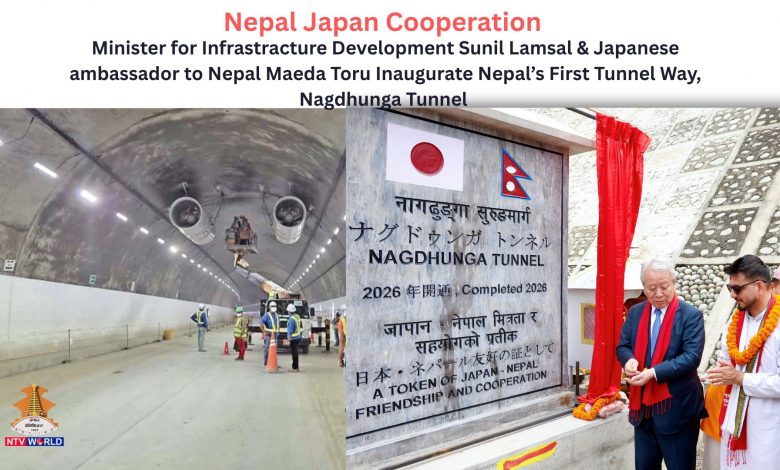
Nepal’s first ever tunnel way, the Nagdhunga–Sisne Khola tunnel, has been formally inaugurated today as the country’s first organized transport tunnel.
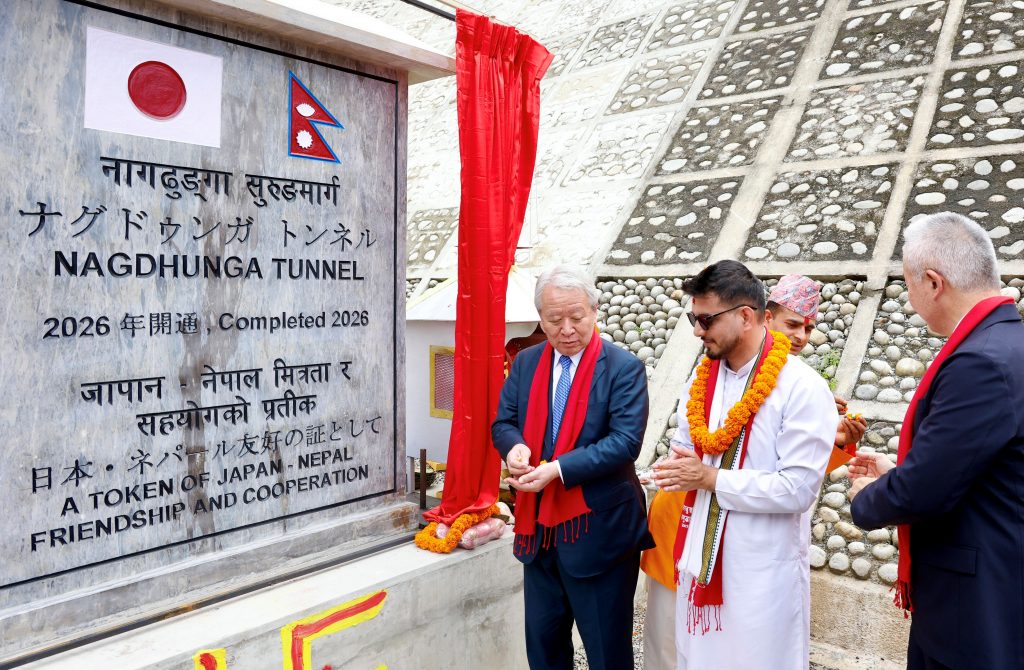
Minister for Infrastructure Development Sunil Lamsal, Japanese Ambassador to Nepal Maeda Toru, and President of the Japan International Cooperation Agency (JICA), jointly inaugurated the tunnel amid a program.
After the inauguration, the construction company has handed over the tunnel to the Government of Nepal.
Initially, ambulances, security vehicles, and other essential services only will be allowed to use the tunnel in the trial period.
For a few days, the tunnel will undergo full testing before being opened to all categories of vehicles. During the trial period, vehicles using the tunnel will not have to pay any toll fees.
The tunnel, with a total length of 2,688 meters, requires vehicles to pay a fixed toll. According to the Department of Roads, cars and vans entering Kathmandu will pay Rs. 65 and exiting Rs. 60.
Minibuses, trucks, and tippers entering Kathmandu will pay Rs. 115 and exiting Rs. 80. Similarly, buses and trucks entering Kathmandu will pay Rs. 260 and exiting Rs. 200.
Pedestrians, two-wheelers, and three-wheelers will not be allowed to enter the tunnel. Vehicles carrying flammable substances such as diesel, petrol, gas, or explosives are also prohibited.
The project consists of two tunnels: the main tunnel for traffic and a rescue tunnel for emergencies. The construction was carried out by Japan’s Hazama Ando Corporation.
According to Ramesh Prasad Koirala, an engineer from Nippon Koei, the consulting firm, the tunnel is equipped with fire-fighting systems, emergency rescue facilities, CCTV cameras, communication systems, and security mechanisms to ensure safety and smooth traffic flow.
Continuous oxygen supply and other essential services have also been arranged. The tunnel starts at Totipakha in Dahachok, Chandragiri Municipality–1, Kathmandu, and ends at Sisne Khola in Dhunibensi Municipality, Dhading. It is expected to save nearly an hour of travel time compared to the current highway, which is congested, steep, and winding.
The construction was funded by a concessional loan of Rs. 21 billion from the Government of Japan and Rs. 6 billion investment from the Government of Nepal. A private operator has already been selected for tunnel operation and management. Security personnel and technical staff will conduct regular monitoring and inspections.
Vehicles using the tunnel will make payments electronically. Although the project was initially targeted for completion within 42 months, the timeline was extended due to the COVID-19 pandemic and other complications.

Comments