
Kathmandu’s Shifting Streets and Silent Stories
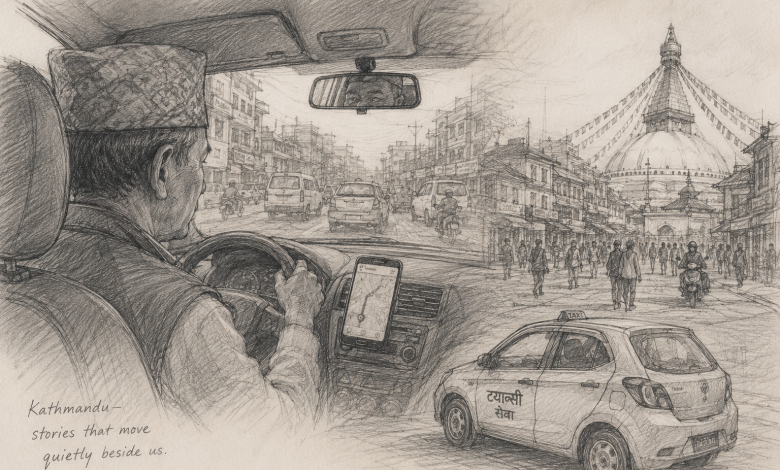
A quick tap on my phone, a tiny beep, and nearby, an engine starts for me. The screen shows a small car crawling closer through Kathmandu’s traffic maze.
What feels like routine technology to most has, for me, become an opening to listen to lives that move quietly beside mine.
Most mornings, I take a cab to work.
The moment I step inside, the outside clamor fades. What takes its place are voices of stories told over rumbling engines and half-open windows.
Some drivers are chatty philosophers, others quiet observers. Either way, those few kilometers often hold more life than a day’s news cycle.
Ride-sharing apps claim to have brought order to the chaos.
The companies proudly speak of transparent pricing, GPS tracking, and safety at your doorstep.
For commuters, it’s comfort. But for many drivers, this so-called order has redrawn their world in unfamiliar lines.
“Before the apps, I knew every passenger by face,” says Hari Dai, a 62-year-old from Patan who has been driving since the 1990s. “Now I just follow a voice from this little screen, even when my head already knows the road.”
He smiles, but the smile doesn’t reach his tired eyes.
Like many older drivers, he wrestles with phones that freeze mid-ride, apps that crash, or maps that misunderstand Kathmandu’s twisted lanes.
When the system lags, silence fills the cab. It is not rudeness, but the strain of someone trying to keep pace with a city racing ahead.
From Bhaktapur, Rajendra drives daily into the capital but still finds its rhythm jarring.
“In Bhaktapur, traffic listens,” he jokes. “Here, even time refuses to move.” Then he lifts his phone. “And this map? It keeps sending me through alleys so narrow that even scooters hesitate.”
Kathmandu’s layout, its spontaneous one-ways, unfinished flyovers, and sudden street rituals, confuses digital systems built for tidy grids. The app may see straight lines; the driver sees detours, potholes, and surprise processions.
Some drivers, though, are charging into the future. Bishnu, who lives near my neighborhood, runs a white electric taxi. He beams as he points to it.
“I bought her for 4.5 million rupees,” he says proudly. “Still have three million to pay back, but when I glide by, people stare. It feels good.”
Electric vehicles have become quiet status symbols. Yet that pride carries risk: spare parts cost a fortune, charging stations are scarce, and a single battery failure can erase months of earnings. “But if you wait for the road to be smooth,” Bishnu shrugs, “you’ll never drive.”
Then come the young ones, restless, hopeful, often new to the city.
One twenty-something driver tells me he left a restaurant job to buy a used cab with a cousin. “Now I answer to no one,” he says, adjusting the mirror. “Next year, I’ll own one.”
Another man in his late thirties once worked as a government clerk. After his daughter was born, he quit, bought a cab, and started fresh.
Twenty-two years later, he owns two cabs and a small home. “My daughter studies overseas,” he tells me, almost shyly. “She says every job has dignity where she lives. That keeps me driving.”
The ride-sharing companies post glowing figures, thousands of daily trips, rising EV adoption, lower emissions.
Yet those statistics skip the heartbeat behind the wheel: the anxiety over monthly installments, the quiet pride of self-employment, the exhaustion of traffic jams that swallow hours of life.
Driving in Kathmandu is no longer just about steering through streets, it’s about steering through change.
Kathmandu’s taxi culture mirrors the country itself, old traditions brushing against modern ambition.
Within each ride lives a small reflection of Nepal’s transition, handwritten ledgers giving way to digital dashboards, loyalty replaced by star ratings, face-to-face trust balanced against algorithmic precision.
When my ride ends and the app chirps Trip completed, I rarely rush out. I sit for a moment, listening to the hum of the engine cooling down.
These drivers weary, witty, or quietly proud have shown me the city from a perspective that no skyline or statistic can match.
On these restless roads, through fumes and laughter, Kathmandu keeps talking.

Comments