
Nepal Can be a Bridge in Expanding Cooperation Between China and South Asia: Foreign Minister Khanal
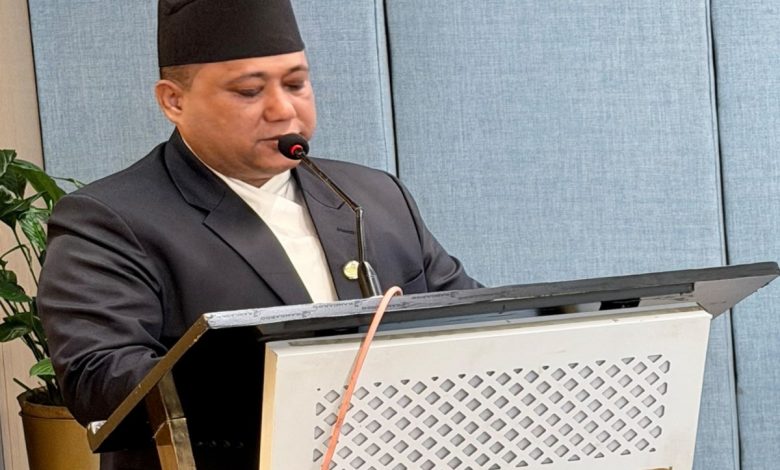
Foreign Minister Shishir Khanal has said Nepal can serve as a dynamic bridge in expanding economic, trade, and people‑to‑people cooperation between China and South Asia.
Addressing the international conference on ‘China and South Asia in a Multipolar World: China–India–Nepal Trilateral Relations in an Evolving Regional Order’ held in Lalitpur on Friday, Minister Khanal emphasized that Nepal has been independently strengthening relations with both neighbors on the basis of sovereign equality, mutual respect, mutual benefit, and sensitivity to each other’s legitimate concerns.
He highlighted Asia’s rapid economic transformation as creating unprecedented opportunities for shared prosperity, stressing that cooperation is the most reliable path to sustainable and long‑term development.
He noted that the continuous economic rise of China and India has opened new avenues for Nepal and neighboring countries in trade expansion, investment attraction, infrastructure and connectivity development, tourism promotion, and broader economic collaboration.
Minister Khanal clarified that economic diplomacy lies at the core of Nepal’s foreign policy, with its primary objective being the improvement of citizens’ living standards. “Our foreign policy is linked to enhancing the quality of life of our people. Creating opportunities in trade, investment, employment, entrepreneurship, tourism, technology, innovation, and sustainable development is its fundamental goal,” he said.
Despite South Asia’s vast economic potential, he observed that regional integration has remained limited. Strengthening connectivity, facilitating trade, boosting investment flows, and reinforcing supply chains could yield significant economic benefits.
“The success of our cooperation should not be measured by how many agreements we sign, but by how many opportunities we create for our citizens,” he remarked.
He underlined that the current government has prioritized economic transformation, focusing on quality investment, infrastructure development, export promotion, tourism, clean energy, digital transformation, innovation, and private sector growth.
Nepal, situated between two large and fast‑growing economies, aims to transform its landlocked status into an opportunity by becoming a vibrant and dynamic bridge linking China and South Asia.
Minister Khanal pointed out Nepal’s investment potential in more than 42,000 MW of economically viable hydropower, rich biodiversity, abundant water resources, fertile agriculture, and an expanding digital economy.
He also emphasized Nepal’s “soft power” assets, including the birthplace of Lord Buddha, the spiritual legacy of Guru Padmasambhava, Mount Everest, and UNESCO‑listed heritage sites.
He called for stronger regional cooperation in energy security, climate change, digital transformation, research, innovation, and people‑to‑people ties, urging universities, research institutions, and think tanks to deepen collaboration.
Stressing the need for partnerships based on trust, mutual respect, and shared interests in a multipolar world, he affirmed Nepal’s commitment to playing a constructive and positive role. “Asia’s future will not be determined only by the size of its economies or the speed of its technology, but also by the quality of partnerships we build and the trust we foster,” he said.
The international conference was jointly organized by the Nepal Institute for International Cooperation and Engagement and Fudan University’s South Asia Studies Center.

Comments