
PM in Advance: New Normal or Matching Strategy?
Devendra Subedi
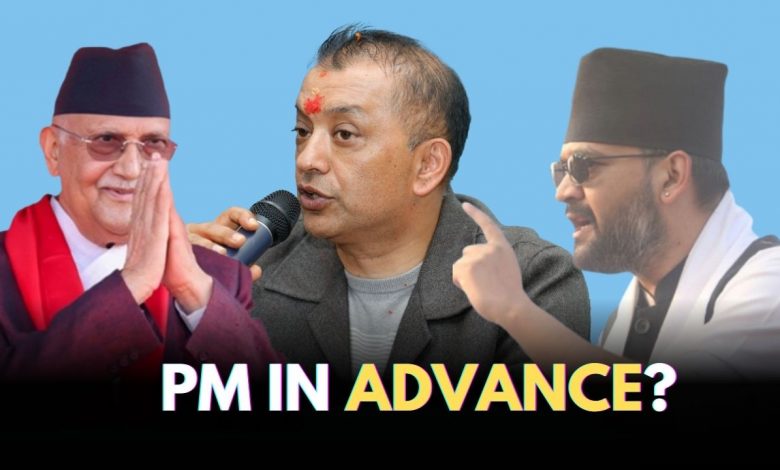
Nepali Congress has become the third party to declare its Prime Ministerial candidate for March 5 election to match the strategies of imminent rivals.
Though there is no harm in declaring the candidate in advance, but is there a guarantee that the candidate will not change?
As per constitutional provisions only the leader of the parliamentary party of the political party can stake claim for the top post, not the central committee decided or secretariate endorsed.
Rastriya Swatantra Party RSP was the first to decide the Prime Ministerial candidate in former Kathmandu mayor Balendra Sah who joined the party much later then the declaration.
CPN UML was not much behind as it’s secretariat meeting expectedly decided to project chair KP Sharma Oli as its Prime Ministerial candidate.
This is an entirely new practice in Nepali politics, something not seen in any of the parliamentary elections since 1990.
Constitutionally, the decision of party instruments on who will be the next prime minister does not hold any obligatory ground.
As per the provision, only the leader of the parliamentary party that is formed by the elected lawmakers of the lower and the upper houses of the parliament, is eligible to become the Prime Ministerial candidate.
If that is the legal provision, then why are the parties declaring their Prime Ministerial candidates one by one?
Political analyst Bishnu Sapkota says it is a move to show that the party is coming to the election with fresh air and new face to lead the country.
While CPN UML has not been much aloud on championing former Prime Minister Oli as the candidate, RSP and Nepali Congress are very vocal and aggressive.
The publicity is largely because Gagan Thapa and Balendra Sah are the new faces who, to a larger extent, reflect the sentiments of recent Gen-Z movement in the country.
Though there is no meaning of party instrument declaring a candidate ahead of the election, this has been done to woo the voters by showing that the party has embraced change.
According to Sapkota though Nepali Congress and CPN UML might not have any issues in their parliamentary party to back the same candidate, having a separate individual leading the party and the parliamentary party can lead to confrontation. Ugly confrontation for Prime Ministerial berth has been seen in the past as well.
Though there is no guarantee that the parties who have declared their Prime Ministers in advance will bag majority or get to lead the coalition, but a question arises what will happen if the announced candidate does not get the favor of the parliamentary party.
According to Sapkota if the declared Prime Minister and real Prime Minister are different, that would amount to not only cheating but deception to the voters.
Sapkota opines that using the popular face to impress the voter not just under first-past-the-post but also under proportional representation system, though a distant possibility, cannot be forgiven.


Comments