
Paddy Production Declines, Farmers Struggles to Get Fair Prices
Rojina Rai/Dinesh Bista
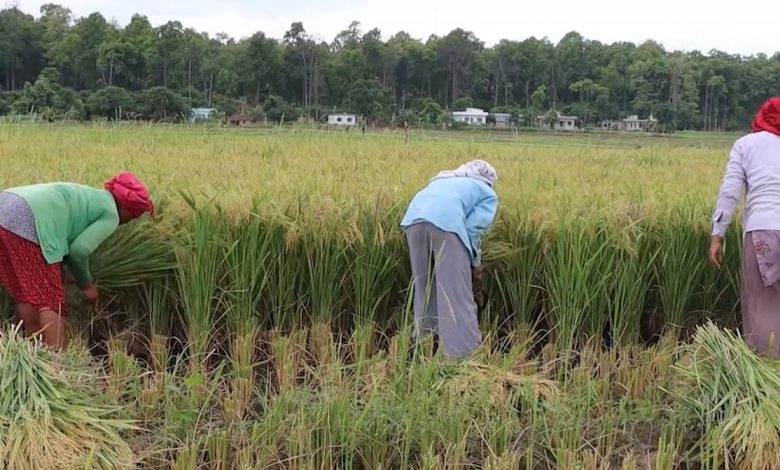
Farmers in key districts in western Nepal, Kailali and Kanchanpur struggle to get fair prices for their paddy this year.
The government procurement quotas have forced them to sell to private traders compromising at low rates.
While rice imports from India continue to rise.
Seasonal paddy production in Nepal’s Far western Region is projected to decline by approximately 5% compared to the previous year.
Over the years the region has demonstrated a high rate of paddy cultivation completion during time period.
However, the region faced potential production shortfalls this year.
The summer monsoon drought and later unseasonal rains during harvest largely affected the production.
The region typically contributes about 10% of Nepal’s total rice production.
Despite being major contributors, the farmers in two major far western districts in Nepal, Kailali and Kanchanpur are forced sell their produces at a compromised price.
This is leading to financial distress.
Farmers lament the influx of cheaper rice from India has made it difficult for them to sell their paddy and even recover production costs.
The paddy production this year in Kanchanpur recorded two hundred eighteen thousand metric tons of production.
Kailali recorded three hundred eight thousand 434 metric tons.
Production declined in Kailali by 5.26 percent compared to last year. In contrary Kanchapur sees a slight increase.
Only a small portion 6, 000 out of procured 40,000 quintals were purchased by the Food Management and Trading Company Limited.
Having some additional procurement under the government quota, the majority of farmers’ paddy remains stockpiled in warehouses.
Being forced to sell paddy at prices that fail to cover production costs has left farmers severely affected.
Meanwhile, as domestically produced paddy fails to find a market, rice imports from India continue to rise sharply.
The government has fixed the minimum support price for coarse paddy at 3,463.81 rupees equivalent to 23.79 US Dollars per quintal.
However, the current market price has fallen to as low as 16.49 US Dollars per quintal. Stakeholders warn that in Nepal, a country known for its agrarian economy, the inability of domestic farmers to receive fair prices for their produce, coupled with the annual consumption of Indian rice worth billions of rupees, signals a deepening crisis in the agricultural sector.



Comments