
JICA Enhances Support for Nagdhunga Tunnel with Additional Loan
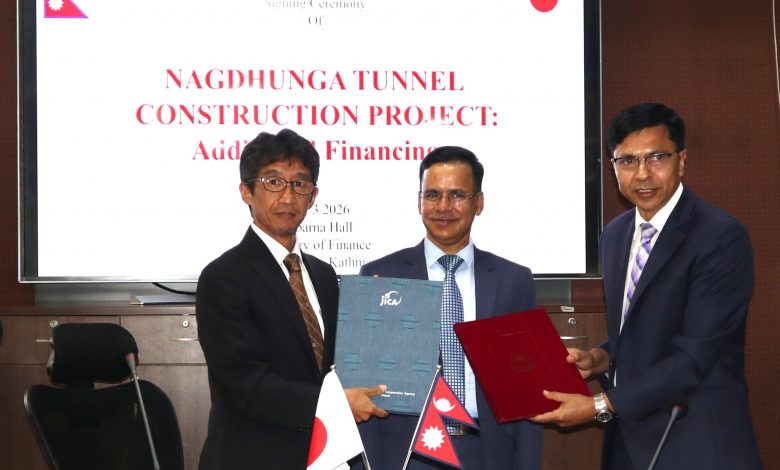
An additional ODA Loan of 5.7 billion Japanese Yen for the “Nagdhunga Tunnel Construction Project” was signed today, bringing total loan to over 22 billion Japanese yen.
The Exchange of Notes regarding the additional assistance was signed by Ghanashyam Upadhaya, Secretary, Ministry of Finance on behalf of the Government of Nepal and Mr. Maeda Toru, Ambassador of Japan to Nepal on behalf of the Government of Japan today, the Japan International Cooperation Agency (JICA) stated.
Similarly, the Loan Agreement was signed by Dhani Ram Sharma, Joint Secretary, Foreign Aid Coordination Division (FACD), Ministry of Finance on behalf of GoN and Matsuzaki Mizuki, Chief Representative of JICA Nepal Office.
The Nagdhunga Tunnel Construction Project is designed to enhance transportation around the Nagdhunga pass, improving connectivity between Kathmandu and other important areas in Nepal.
The construction of the Nagdhunga tunnel way has reached the final phase. With about 99 percent of the physical progress being made, the tunnelway is expected to be open to the public from July 2026.
The 2.68 km tunnel will significantly change travel in the region and set the stage for future infrastructure projects, supporting Nepal’s growth and development. This initiative will leverage modern tunneling technology to promote economic resilience and sustainable development beyond the tunnel itself.
This initiative supports SDG Goal 9: Industry, Infrastructure and Innovation, reaffirming Japan’s ongoing commitment to improving Road Network in Nepal.
Nepal’s collaboration with Japan, particularly through JICA, has led to significant advancements in road construction and infrastructure development in Nepal.
Some notable achievements include the 160 km BP Highway -Sindhuli Road and Kathmandu-Bhaktapur Road Spanning 9.1 km., and numerous bridges in Kathmandu valley as well as in the rural areas. Hence, it is assured that Nagdhunga tunnel will also be a world class construction in the history of Nepal’s infrastructure. (RSS)



Comments