
Japan and Australia Refuse Naval Deployment to Strait of Hormuz Despite Trump Call
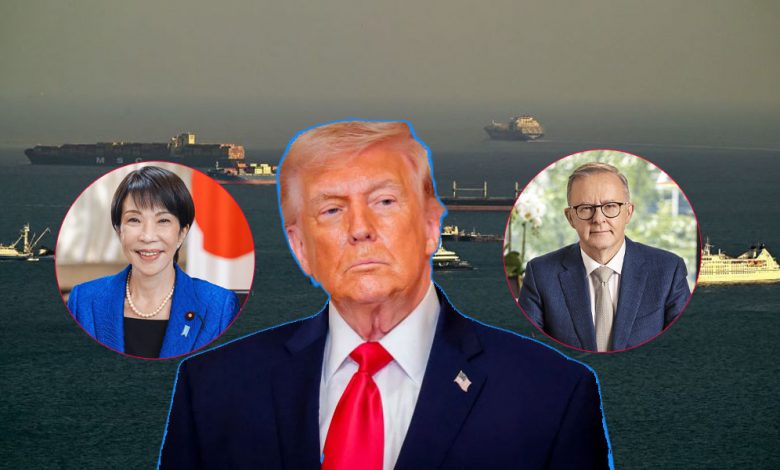
Japan and Australia has refused to deploy their naval to Strait of Hormuz despite a call from the U. S. President Donald Trump.
Japan said Monday it was not currently thinking about ordering maritime security operations, after US President Donald Trump called for other countries to send warships to help protect the Strait of Hormuz.
“In the current Iran situation, we are not at the moment considering issuing a maritime security operation,” Defence Minister Shinjiro Koizumi told parliament.
Trump called for reinforcements on Saturday from countries including Japan after earlier vowing that the US Navy would “very soon” begin escorting tankers through the vital shipping lane for oil in the Middle East.
Japanese Prime Minister Sanae Takaichi said Monday that she had not received a request from Trump.
“The question is what Japan should do on our own initiative and what’s possible within our legal framework, rather than what’s requested by the United States,” she told parliament. “We have asked various sections of various ministries to discuss this.”
Any maritime security operation would be “extremely difficult legally”, she added.
Sending its Self-Defense Forces abroad is politically sensitive in officially pacifist Japan, as many voters support the US-imposed, war-renouncing 1947 constitution.
Takayuki Kobayashi, the policy chief of Takaichi’s ruling Liberal Democratic Party, said Sunday the threshold was “extremely high” for Tokyo to send in its warships.
The world’s number-four economy is the fifth-biggest importer of oil, with 95 percent of it coming from the Middle East and 70 percent passing through the Strait of Hormuz.
Iran has effectively closed the strait in retaliation for the US-Israeli war against Tehran.
Australia will not send navy ship to Strait of Hormuz, official says
Australia will not send navy ships to protect oil tankers in the Strait of Hormuz, a senior government minister said on Monday.
Australia is well-prepared for the “economic crisis” caused by the ongoing conflict in the Middle East and would not be sending a warship to the region, said Minister for Infrastructure, Transport, Regional Development and Local Government Catherine King, also a member of Prime Minister Anthony Albanese’s Cabinet, according to the Australian Broadcasting Corporation (ABC) radio.
King said that Australia’s fuel stockpile was sitting at 37 days of petrol, 30 days of diesel and 29 days of jet fuel as of Monday after the government reduced minimum stockholding obligations and temporarily amended fuel quality standards to allow higher sulfur levels.
“We’re well-prepared here in this country to weather the economic crisis that is occurring as a result of the Middle East,” she said.
The federal government on Saturday issued a warning to citizens not to transit through Bahrain, Iran, Iraq, Israel, Kuwait, Lebanon, Palestine, Qatar, Syria, Yemen and the United Arab Emirates (UAE).
The Department of Foreign Affairs and Trade had previously issued travel warnings for all of those countries through its Smartraveller service, but said on Saturday that Australian citizens should also avoid transiting through them, even if they do not plan to leave the airport.
It said that the conflict is likely to escalate further and flights could change or stop suddenly. (AFP/XINHUA)


Comments