
Former PM GP Koirala’s 16th Memorial Day Today
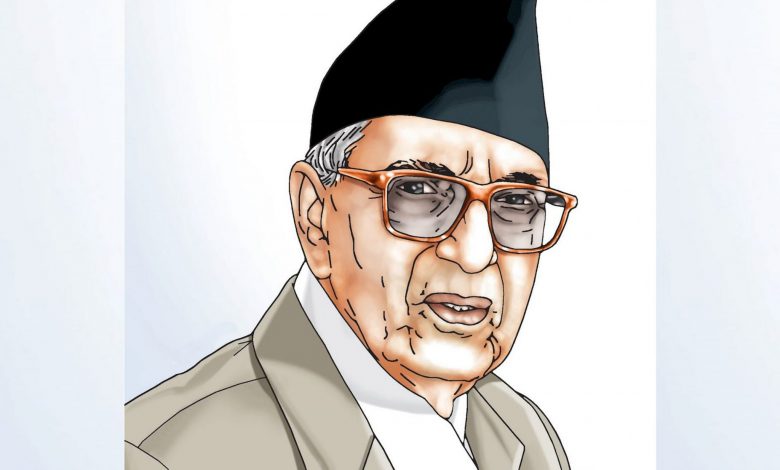
Former Prime Minster and former President of the Nepali Congress (NC) Girija Prasad Koirala’s 16th Memorial Day is being observed today with several programmes.
Koirala who served four times as the Prime Minster of Nepal breathed his last on 20 March 2010 due to Pneumonia related complications.
He had played a lead role in ending the decade-old Maoist insurgency and bringing the then rebel to the peaceful political mainstream.
It may be noted that people’s attraction to the monarchy had begun waning when the then Shah King Gyanendra expelled the popularly elected Prime Minister Sher Bahadur Deuba on 4 October 2002 and subsequently appointed Prime Ministers of his confidence.
It is Girija Prasad who spearheaded the struggle waged against the autocratic move of the then monarch against democracy.
Koirala unified all the political parties and led a movement to establish full democracy under his leadership when the then King imposed a ban on political parties and took absolute power as the chairperson of the council of ministers himself in 1 February 2005.
Under Koirala’s leadership, the monarch on 24 April 2006 had agreed to reinstate the dissolved House of Representatives following the roadmap laid out by the seven parties involved in the movement, which is also popularly referred to as Nepal’s ‘Magna Carta.’
With the success of the people’s movement, Koirala became Prime Minister of Nepal for the fourth time. The reinstated House of Representatives, on 18 May 2006, curtailed all powers of the king, limiting him to a ceremonial role.
Likewise, the integration of the Maoist People’s Liberation Army and management of arms was done under Koirala’s leadership.
Importantly, under his leadership, the Congress planned for a Constituent Assembly election after more than six decades of its demand.
The dream of the NC founders, including his own elder brother BP Koirala to write country’s Constitution through Constituent Assembly election for more than six decades was translated to action on April 11, 2008 under GP’s leadership.
Albeit the first Constituent Assembly was unable to promulgate the Constitution, it became an epoch-making milestone in the history of Nepal.
With the first Constituent Assembly election, the armed Maoist party (NCP) also participated in the parliamentary multi-party political competition.
Koirala also held the responsibility of acting Head of State during his last term. When monarchy was abolished with the dismissal of then King, Koirala assumed the role of acting Head of State.
Under his leadership, on 28 May 2008, the Shah dynasty having a history of 240 years came to an end in Nepal, and the country was transitioned to a Federal Democratic Republic.
He was established as a politician who delivered on his promises.
In memory of Koirala’s contributions to establishing peace in Nepal, today, the Nepali Congress, along with its sister and benevolent organizations, hosted various programmes to observe the 16th death anniversary of Nepal’s towering political figure Koirala. (RSS)


Comments