
FNJ Global Media Conference Ends with Tokyo Declaration
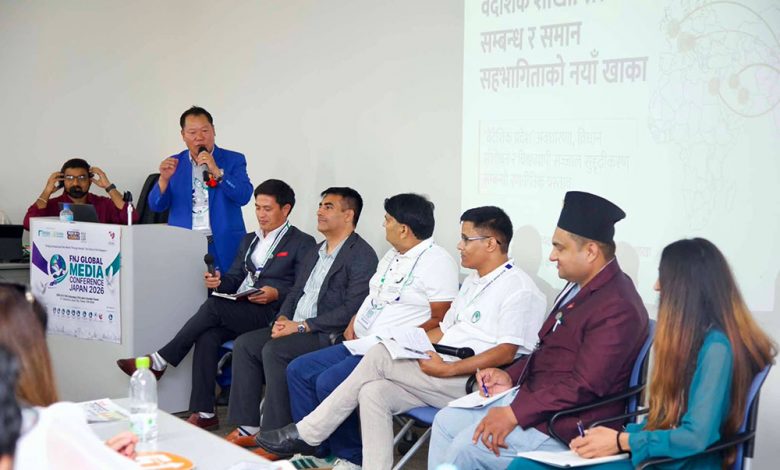
The ‘FNJ Global Media Conference-2026’ held in Tokyo, Japan ended with a nine-point ‘Tokyo Declaration’ covering issues including protection of press and freedom of expression, implementation of the rights of working journalists, institutional strengthening of overseas journalism.
The Declaration of the Media Conference held on July 25 in Tokyo was made public by issuing a press release by the Federation of Nepali Journalists (FNJ) here today.
The event was organized by the FNJ Japan chapter and co-organized by all foreign chapters of the Federation in Europe, the UK, Belgium, Kuwait, Qatar, South Korea, the United Arab Emirates and India on the occasion of the 70th anniversary of Nepal-Japan diplomatic relations. Nepal American Journalists Association and Nepal Australian Journalists Association, affiliates of the FNJ were the co-organisers.
Among others, the Declaration calls for policy measures related to modern technology including artificial intelligence (AI) , has emphasized that freedom of press and expression guaranteed by the constitution should not be directly or indirectly restricted.
The conference, attended by FNJ President Nirmala Sharma and office bearers of foreign chapters, pointed out the need to consult representatives of concerned bodies while formulating or amending media-related laws, urging the government to ensure a press-friendly environment in Nepal.
In the Declaration, attention has been drawn of both media organizations and the government to ensure effective implementation of the Working Journalists Act, minimum wages, service benefits, social security, appointment letters, insurance and other labour rights.
It has also urged to formulate necessary policies and regulatory arrangements to manage the challenges arising from the rapid development of information and communication technology and the use of artificial intelligence.
The Declaration recognized journalists who are engaged in journalism while promoting the Nepali language, literature, culture and national interests while in overseas.
Commitments were also expressed to utilize the knowledge, skills, research experience and modern communication practices acquired by Nepali journalists in overseas in the development of journalism in Nepal.
A decision was reached during the conference to establish the ‘FNJ Global Journalism Award’ in recognition of the contributions of Nepali journalists working abroad.



Comments