
Ancient Newa Manuscripts Maintained Online with Japanese Support
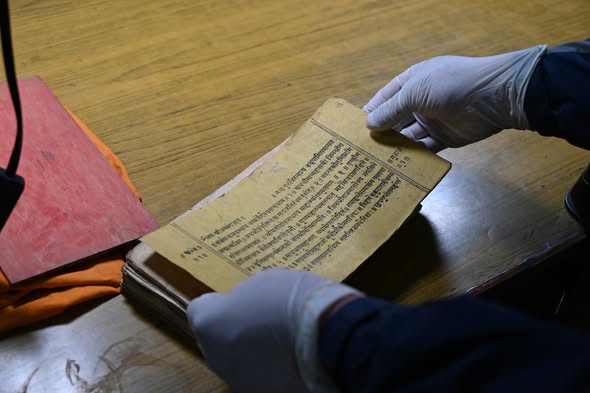
In partnership with UNESCO, the Archive Nepal has digitized more than 30 rare and endangered manuscripts dating back 200 to 800 years with the support of the Japanese government. The online repository was maintained under UNESCO’s Memory of the World Framework.
Archive Nepal marked this milestone on August 8 with the closing event, ‘Preserving the Past, Empowering the Future: Manuscript Preservation in the Digital Age’ which was held in Kathmandu.
The achievement caps an initiative that ran from November 2025 to August 2026 and mobilized a multi-generational network of more than 50 volunteers. Many were young people learning to read their own ancestral scripts for the first time. Together they converted manuscripts held across four sites in the Kathmandu Valley, including private custodian collections and community temples in Patan, into open-access, machine-readable digital records on Wikisource, according to UNESCO Nepal Office.
Acting mayor of Kathmandu Metropolitan City, Sunita Dangol, said, “Preserving manuscripts is not just about preserving what was written in it. It’s also about gaining the knowledge of what has been written in it. As KMC, we have always been working on preserving our past and promoting it and handing it over to future generations. So let’s collaborate together, let’s work hand-in-hand.”
The final event shared the project with the public through: a physical manuscript exhibition, a panel discussion among key stakeholders, and a live transcription showcase. Attendees had the rare opportunity to view original manuscripts up close, written in the Ranjana, Bhujimol, and Prachalit scripts, offering a tangible and emotional connection to centuries of Newa culture and history.
The event’s panel discussion, ‘Guardians of the Written Word: Digital Preservation of Newa Manuscripts and Collective Responsibility,’ brought together manuscript custodians Suresh Bajracharya, Shivesh Sharma of Bhimsen Mandir, and Nepal Bhasa script expert Nitu Dangol, moderated by Archive Nepal’s Director of Operations, Dristi Manandhar. The discussion and audience interaction offered a moment to look back on the project’s journey and a call to action, marking the close of this project phase. It also opened a broader conversation on the shared responsibility of safeguarding Nepal’s documentary heritage.
UNESCO Representative to Nepal, Jaco du Toit, acknowledged the custodians, saying they had protected such rare manuscripts over generations. “Many of these documentary collections have survived because families, temples, monasteries, guthis and local institutions recognized their value and accepted the responsibility of caring for them, often under difficult conditions and with limited resources,” he added.
The project’s community-based approach, pairing traditional custodians with trained volunteers and open digital platforms, offers a replicable framework that could be extended to other endangered scripts and collections across Nepal and beyond.
During the closing event, trained volunteers showed how manuscript pages are digitized on Wikisource in real time. Guests watched the process and followed a live dashboard tracking new pages as they were added.
An Archive and Operation Officer at Archive Nepal, Saroja Hakuduwal, “A project like this is never the work of one person, it is the work of many hands, hearts,and quiet acts of faith along the way. We extend our deepest gratitude to UNESCO under the Memory of the World Framework, the Government of Japan for their vital generosity, our dedicated Archive Nepal team, our partners, and the incredible custodians, transcribers, and community leaders who gave their time to this work. Because of all of you, these manuscripts, once fragile and fading, are now openly accessible, permanently preserved, and available to the world forever.”
All digitized manuscripts are now available open to the public through Wikisource and Archive Nepal’s digital library, where researchers, students, and community members can now view, search, and engage with texts. (RSS)


Comments