
How a Ward Official’s Idea Changed the Identity of Reshgaon into ‘Tea Village’
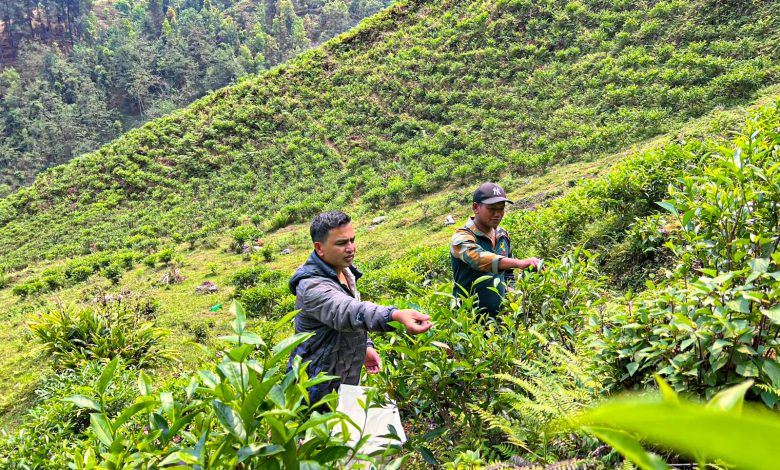
As outmigration increased in Reshgaon, the upland agricultural fields began to be covered with bushes.
Worried as the land in the village started to turn fallow day by day, the local ward chairperson, Prem Lamichhane, devised a plan to cultivate tea on these upland fields.
Currently, Ward Chairperson Lamichhane’s strategy has paid off and started to become a strong means of income generation. Not only that, the identity of Reshgaon itself has begun to change.
Nowadays, Reshgaon has become known as a tea village. In Reshgaon, located in Ward No. 7 of Kathekhola Rural Municipality in Baglung, tea cultivation is spreading, attracting the other locals as well.
After the tea cultivation started seven years ago began to flourish, villagers have started planting tea even on barren land.
The locals who were ready to migrate out from the village before this have now thought of staying back. The tea gardens near the village have not only brought happiness to the villagers but have also started contributing to their income.
About 30 thousand tea saplings were brought from Sirubari of Tarakhola Rural Municipality in 2076 B.S. for test cultivation. Initially, when planting the saplings, many did not even believe that they could earn income from it.
“Some people used to say ‘you have started doing the impossible’. But gradually, as the plants grew well, hope has arisen among the locals,” the ward chairperson Lamichhane said.
According to him, tea production has started since last year and there is much more production now compared to last year.
“We are very excited after the tea cultivation has prospered; the land that was barren in the past is now covered with tea bushes, and we have started making money from this. We have begun to engage all the villagers and expect that outmigration will stop to some extent, as many people have personally started planting tea plants,” he said.
Initially, tea cultivation was started on 35 ropani of land at Janakalyan Basic School, and now tea has been planted on many vacant barren land plots in the village.
The ward chairperson Lamichhane states that even the bushes on the vacant lands in the village have been cleared to plant tea.
Tea cultivation was started through the Resh Small Farmers Cooperative. According to Ward Chairperson Lamichhane, tea can be harvested for nine months of the year.
This year, it was harvested twice and the harvested and processed tea is being sold at two thousand rupees per kilogram. This year, tea sales are expected to reach Rs 2 million.
Ujeli Sharma, president of Resh Small Farmers Cooperative, stated that although tea production was good, there was a problem due to the lack of processing machines.
There is no market problem for the tea produced here. Currently, locally produced tea is reaching markets in Baglung, Pokhara, Kathmandu and other cities, she said.
Currently, tea is cultivated over 300 ropanis of land in Resh village, including Tingring, Baur, and Phalayadanda. About 280 families from the village are involved in tea cultivation. (RSS)



Comments