
Women Lead in Numbers, Lag in Voter Registration
Sabika Shrestha
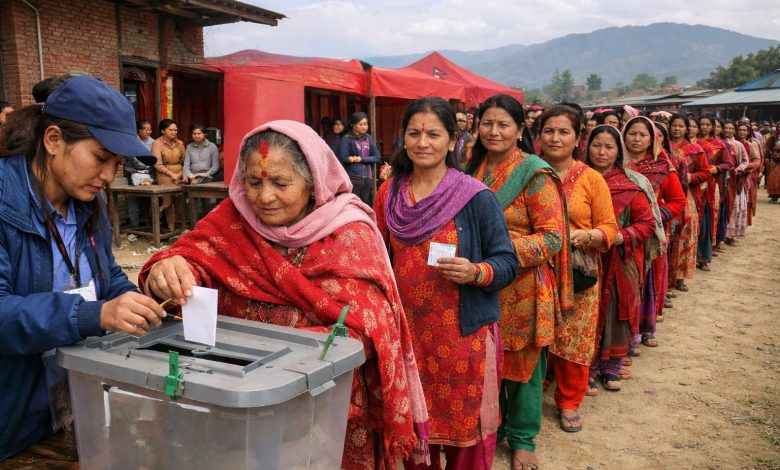
Women form the majority of Nepal’s population, yet they remain underrepresented in voter rolls and electoral politics.
Data from the Election Commission of Nepal exposes a persistent gap between constitutional promises of inclusion and the ground reality of women’s political participation.
Despite constitutional guarantees of proportional inclusion, women’s political participation in Nepal continues to lag behind their demographic majority.
According to the 2021 national census conducted by the Central Bureau of Statistics, women make up 51.1 percent of Nepal’s total population.
Yet data from the Election Commission of Nepal shows that women account for less than half of registered voters in the upcoming House of Representatives election.
Out of 18.9 million registered voters, women comprise roughly 48.9 percent, while men make up 51.1 percent.
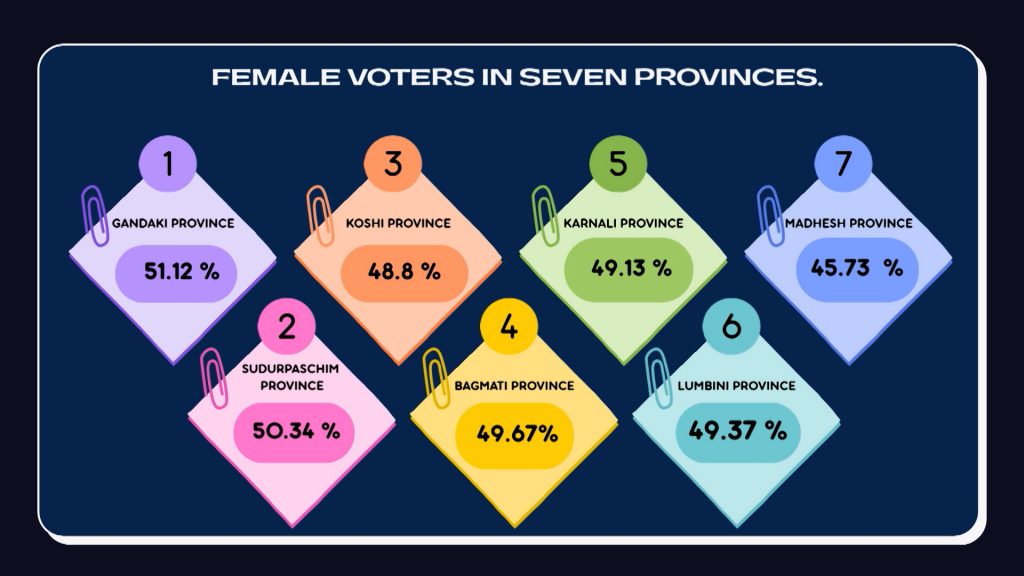
The gap is striking: although women outnumber men in the population by more than 650,000, there are over 423,000 fewer female voters than male voters.
Observers say the disparity highlights structural and social barriers that continue to exclude women from full political participation.
Information Officer of the Election Commission, Suman Ghimire, highlighted some of the challenges contributing to lower female voter participation in recent elections.
“One of the reasons could be that our education efforts during the election campaign were insufficient or less effective.
Another factor is that this time, voter list collection required individuals to visit the district headquarters. Although we collected some data through the National ID (NID) system in the last six to seven days, the process otherwise required physical presence, specifically at the district headquarters. This requirement likely made it inconvenient for women voters to travel there, as many could not leave household chores unattended,” Ghimire explained.
In many parts of the country, women remain confined to domestic roles, limiting their mobility and access to public services.
While online registration options exist, digital illiteracy and limited internet access further restrict participation.
Gender and Social Inclusion expert Sharu Joshi added that structural and socio-economic barriers also play a significant role in limiting women’s participation.
“First, many women may not possess citizenship documents. Second, household work burdens may restrict their mobility. Third, lack of access to smartphones or computers can prevent them from registering. Fourth, a large number of women work in the informal sector, where missing even a day’s wage to travel to headquarters or other registration centers can be costly. Finally, because of multiple factors many women may simply lack access to crucial information about the registration process,” Joshi noted.
She emphasized that political participation is not only about voting but also about representation and decision-making power.
Although Nepal’s Constitution mandates proportional representation, women’s candidacy in directly elected seats remains significantly low.
Joshi also highlighted the persistent challenges women face in balancing household responsibilities with civic engagement. “Women are six times more overburdened by household work, and in South Asia, Nepal’s statistics are particularly high. We must also consider other factors affecting women’s participation,” Joshi said.
She pointed to voter turnout as a growing concern, noting that in the 2022 election, there were over 335,000 fewer women voters, while in 2026, the number of women voters missing from the rolls has risen to more than 427,000. “This is a serious issue,” she stressed, adding that the Ministry of Women, Children, and Social Welfare, along with the Women Commission, should conduct research to understand why fewer women are voting.
As Nepal prepares for another election cycle, the gap between constitutional ideals and ground realities underscores the urgent need for stronger policies and inclusive implementation to ensure genuine political empowerment for women.
Comments