
Saraswati Pooja Bridges Tradition to Modern Theories of Learning in Children
SP Upreti
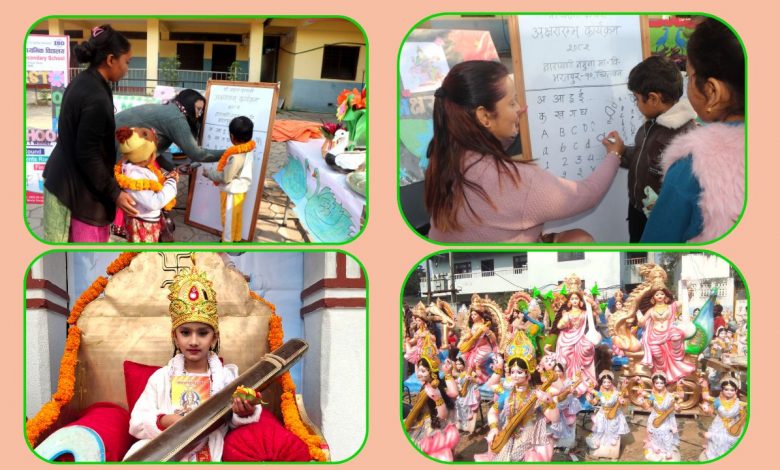
Nepal has a rich history of multicultural practices that define and span from birth to death. One of them is the way Nepali children begin their education with special ritual. For this purpose, the country has a sacred festival dedicated to knowledge, wisdom and arts, Saraswati Pooja, also known as Basanta Panchami or Shree Panchami. Saraswati is one of the three Goddesses in Hindu trinity, alongside Lakshmi and Parvati. She is the revered Hindu deity of knowledge, wisdom, music, arts and speech.
‘Saraswati’ is derived from the Sanskrit words, where ‘Saras’ means a body of water or speech and ‘vati’, refers to woman, symbolizing the ‘Goddess of Speech’ or ‘the essence of self’. It is observed every year in the fifth day of the waxing moon in the month of Magh, devotees throng to Saraswati temples across the country to worship Saraswati.
According to the Rigveda, Saraswati is considered to be the purifier, signalling the transition from darkness to brightness. It is believed that Saraswati holds the special power of intelligence and creation, contributing to the manifestation of the universe.
Goddess Saraswati is typically depicted holding a Veena, a book, a mala and a water pot, symbolizing purity, true knowledge and representing the creative arts and intellect. The prayer of Saraswati Puja focuses on the pursuit of knowledge and wisdom.
In Hindu rituals, it is recommended to internalize Saraswati for personal improvement, as believing in the power of Saraswati helps in attaining spiritual serenity. Her four arms represent the four aspects of an individual’s inner personality, mind (Mana), intellect (Buddhi), Chitta (conditioned consciousness, memory) and ego (Ahamkar).
Crystal Mala in her right hand indicates ego, meaning that true knowledge acquired with love and devotion melts the ego and results in enlightenment (moksha) from the physical world. Similarly, her attire, white sari, symbolizes that she is embodiment of pure knowledge.
Veena, Saraswati holds, represents the icon of all knowledge. When it is played, a melody of music points out that knowledge can create something that touches your heart and mind, ultimately attaining peace in mind.
The Vedas in her hand indicate pure knowledge, suggesting that one has to believe in the proper and original source of knowledge and information in order to uncover the ultimate truth. Peacocks represent arts and beauty. They also possess the meaning of vanity and indecision, as a reminder to curb these two qualities.
The Goddess Saraswati often appeared with a swan, which reveals the power or ability to discriminate between right and wrong or good and bad, highlighting the power of discernment.
All these symbols together tell a story of creation, wisdom, arts and the power of purity.
Counselling psychologist Kapil Sharma states that children involving in Saraswati Puja can reflect, interact, and participate in social engagement, eventually foster overall learning and social skills among them.
“From the point of view of social learning theory, children don’t learn just from books. They learn from environment and others. Learning happens during the celebration of Saraswati such as they talk, walk, show and involve themselves various activities following seniors”, said Sharma.
Connection of Saraswati Pooja to Modern Theories
Vygotsky’s Social-Cultural Theory
The theory proposed by Lev Vygotsky in 1920, emphasizes that social interactions and cultural facets play a significant role in a child’s overall development, specifically in the zone of proximal development, the gap between the children they can do the things independently and what they can achieve with the help of others.
During the ceremony, children attend school, engage in interaction, learn from their seniors and receive support from them, ultimately paving the way for effective learning. It says that Saraswasti Puja, a traditional ritual, aligns with modern principles, including Vygotsky Social Cultural theory.
Social Learning Theory
A famous theory of learning developed by Albert Bandura, in the 1970s, highlights that learning can occur through societal observation. This means children tend to imitate others’ action. For example, parents’ daily actions, teachers’ behaviour and friends’ activities. Being a societal event, Saraswati Puja serves that environment for allowing children to observe their seniors, teachers, other people during the ceremony, as that would be their first entry to the school, learn to adapt a new experience and observation provide a better step to start anew.
Emotional Intelligence
Another powerful and impactful psychological theory of development and success in life is Emotional Intelligence, developed by Daniel Goleman in the 1990s, refers to the ability of an individual to understand, interpret and utilize one’s own and other’s emotions skilfully.
In Saraswati Puja, children are encouraged to fast for sometimes, they have to wait and maintain patience while staying in a queue for worship. These practices promote and help develop emotional intelligence such as self-awareness, empathy and self-regulation among children and students since childhood.
Nepal’s numerous rituals, deeply rooted in cultural and religious traditions. They are not just a ritual, instead tied with deep and profound meaning. They foster the understanding of life, promote living and maintain peace, increasing happiness and satisfaction. Saraswati Puja significantly serves and aligns with crucial theories of psychology related to learning and development those help in the growth and development of children.




Comments