
Four Years to 2030: Dr. Maheshwar Dhakal on Nepal’s Climate & Biodiversity Leadership
Sarah Sapsanamma Rai
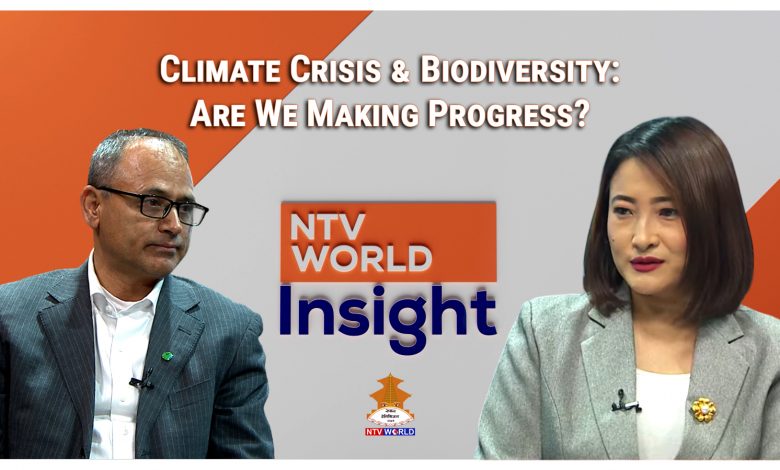
As the world races toward the 2030 deadline for climate and biodiversity targets, progress remains uneven. In an interview on NTV World Insight, Dr. Maheshwar Dhakal, Joint Secretary at Nepal’s Ministry of Forests and Environment and head of the Climate Change Division, discusses the global conservation gap, climate justice, financing challenges, and why mountain ecosystems must be at the center of global climate action.
Q: Less than four years remain until 2030. How far is the world from achieving global biodiversity targets?
The gap is significant. Globally, only about 17.6% of terrestrial areas and 8.5% of oceans are protected, which is far below the 30% target set for 2030. This target is extremely ambitious.
If we look at the global context, many countries failed to meet earlier biodiversity targets agreed under the Convention on Biological Diversity, such as the Aichi Targets adopted in 2010. However, Nepal presents a more encouraging picture. We already have about 23% of our land under protected areas.
The Kunming–Montreal Global Biodiversity Framework, adopted at COP15, reaffirms the 30-by-30 goal but introduces more flexible tools, such as Other Effective Area-Based Conservation Measures (OECMs). These allow conservation outside traditional protected areas, with strong involvement of local communities. Nepal has embraced this approach and has already initiated strategies to implement it.
Q: Is Nepal well positioned to reach the 30% target?
Yes, Nepal is in a relatively comfortable position compared to many countries. We have several biodiversity-rich areas that are not yet formally designated but could be conserved under OECMs.
For example, the Godavari Forest is ecologically intact but not part of the protected area system. Similarly, areas such as Tinjure–Milke–Jaljale in eastern Nepal, Panchase in western Nepal, parts of the Terai lowlands, and high mountain regions like Limi Valley in Humla are strong candidates for conservation.
“Mountains regulate climate and water systems, yet their protection is still missing from global priorities.”
Globally, however, the situation is more challenging. Many developed countries publicly support conservation targets but show limited commitment at the national level. With only four years remaining, meaningful action is urgently needed.
Q: Climate change and biodiversity are often treated separately. Are they really two different crises?
They are deeply interconnected. In 1992, at the Rio Earth Summit, three conventions were adopted together: climate change, biodiversity, and desertification. Over time, climate change has received more political and financial attention, particularly around climate justice.
Biodiversity conservation has also seen progress, but desertification remains less discussed because fewer countries feel directly impacted. In reality, all three issues are interlinked and must be addressed together to protect ecosystems and the planet.
Q: Countries have made commitments under the Paris Agreement and Nationally Determined Contributions (NDCs). Are these targets realistic?
Nepal is fully committed to achieving its NDC targets. However, implementation depends heavily on finance. Our NDCs include two categories: unconditional targets, which we can achieve using domestic resources, and conditional targets, which require international support.
Nepal is a landlocked, mountainous country with very low carbon emissions, yet we are among the most climate-vulnerable. To expand clean energy, especially hydropower, and reduce fossil fuel dependence, we need international financing, technology transfer, and capacity building.
Q: How do global political decisions such as the U.S. withdrawal from the Paris Agreement under Donald Trump affect climate action?
Officially, these are internal decisions of sovereign states. However, the United States is a major global actor, and its absence from collective efforts creates uncertainty.
Many countries are concerned about the future direction of global climate and biodiversity governance. While I hope the U.S. will re-engage fully, the broader challenge is maintaining momentum amid changing geopolitics.
Q: There is a massive funding gap between harmful economic activities and climate action. What needs to change?
The scale of finance required is enormous. Scientific bodies like the IPCC and IPBES clearly show how much funding is needed for climate and biodiversity action, yet current financial flows fall far short.
“Developing countries need climate finance not as aid, but as a fair response to a crisis they did not create.”
Developed countries have benefited from natural resources for centuries, while developing countries now face the worst impacts of climate change and biodiversity loss. This is fundamentally an issue of justice.
Developing countries must negotiate collectively, strengthen scientific evidence, and demand fair climate finance. Regional cooperation especially in South Asia is essential to mobilize resources effectively.
Q: Nepal has been pushing the mountain agenda globally. What progress has been made?
Nepal organized the Sagarmatha Sambad, which clearly emphasized that protecting mountains means protecting downstream communities. Failure to do so results in floods, landslides, and other climate disasters.
As a result of coordinated efforts, COP30 has agreed to hold a Global Dialogue on Mountains and Climate Change in June in Bonn, Germany. Nepal is actively preparing for this dialogue.
We are calling for mountains to be recognized as a distinct agenda under UN climate negotiations, and for the unique livelihoods of mountain communities to be addressed through regular global dialogue.
Q: Are intangible impacts like culture and livelihoods given enough weight in climate negotiations?
Not enough. Mountain communities protect forests, glaciers, and biodiversity, which provide freshwater and act as major carbon sinks. These services help regulate the global climate.
These communities must be compensated through mechanisms such as payments for ecosystem services or innovative financing. Without support, they cannot continue protecting ecosystems that billions of people depend on.
Q: Nepal is a low emitter but highly vulnerable. What does climate justice mean in practice?
Climate justice means access to finance, technology, and capacity building. It also includes support for loss and damage.
“The 30% biodiversity target is ambitious, but many countries still lack the political will to act at the national level.”
Vulnerable populations children, women, the elderly, and people in remote areas are often the most affected. Climate policies must prioritize building resilience for these groups.
Q: Nepal has increased forest cover to about 46%. Can this model be replicated globally?
Nepal’s success comes from community-based conservation. Over the past 30–40 years, we have integrated local communities, women, and youth into forest management.
Now, the next step is sustainable use. We must involve the private sector, promote forest-based enterprises, and treat forests as renewable resources. Conservation and development are not opposing goals they must move forward together.
Q: What would success look like by 2030?
The coming years will be extremely challenging. International politics is unstable, and achieving all global targets by 2030 will be difficult.
However, advances in science and global connectivity provide opportunities. As policymakers in developing countries, we must remain hopeful, strengthen cooperation, and do our best to contribute to global solutions.

Comments