
Study of Pasture Area for Conservation of Snow Leopard and Himalayan Blue Sheep
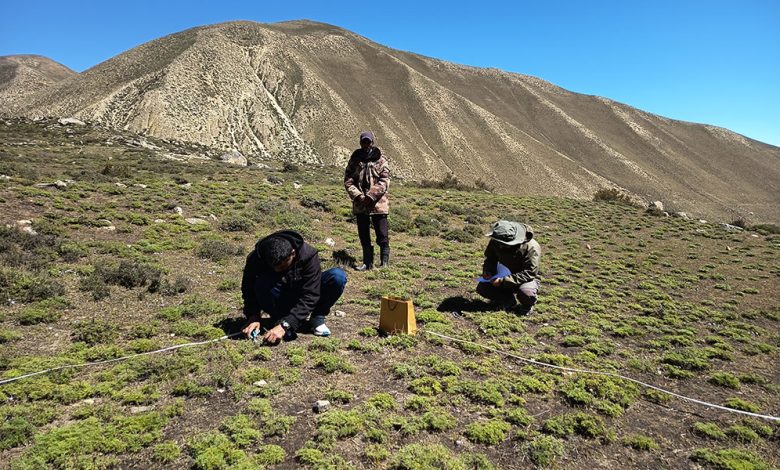
Due to climate change, the availability and quality of grass in the highland grazing areas of Mustang have started to decline, so studies of the grazing areas and collection of grass samples have begun for the conservation of snow leopards and their prey species, the Himalayan blue sheep.
A study of pasture land and collection of grass samples has started in the high-altitude regions of Mustang, which are home to the rare snow leopard, to assess the condition of the grazing areas and the quality of the grass.
Sanjog Thakali, Senior Natural Resource Conservation Assistant of the Annapurna Conservation Area Project (ACAP), told RSS that ACAP’s Jomsom and Lomanthang offices under the National Trust for Nature Conservation are conducting separate surveys to protect and increase the population of the snow leopard’s prey species, the naur or the Himalayan blue sheep.
In the lower Mustang area, one camera has been installed to study snow leopards, and in the upper Mustang, the pasture land and grass are being studied in four areas, including at three places. Grass samples will be collected from those areas to measure the current grazing condition, the species and diversity of grasses, the amount of organic matter, and the state of nutrients.
In this connection, grass samples are being collected in Baragung Muktichhetra and Gharpajhong Rural Municipality by creating 10 square meter plots and designating one square meter subplots within each plot. Thakali said that samples of grass the Naur feed on would be collected from 15 plots of pasture land in Baragung Muktichhetra and nine in Gharpajhong rural municipality and their 48 subplots in lower Mustang.
Samples are being collected in high-altitude areas of Baragung Muktichhetra like Sangta, Phalyak, Lupra, Muktinath, Kagbeni, and Jhong. Thakali mentioned that in areas where cameras are installed, samples are taken maintaining a minimum distance of 500 meters from one section to another.
Similarly, in Upper Mustang, ACAP Lomanthang has started measuring the pasture and grass quality in three areas where cameras were previously installed for snow leopard studies. Umesh Paudel, the head of ACAP Lomanthang, said that to increase the snow leopard population, it is necessary to increase the number of its prey species, which requires improving grazing areas and the quality of grass. Grass samples are being collected from 150 plots in Lomanthang and Loghekar Damodarkund rural municipalities.
He mentioned that in three areas designated for snow leopard studies, the grazing areas within a five-square-kilometer grid structure are being included for sample collection. Based on the area covered by grass, samples will be collected from a maximum of 40 to 50 plots. During the survey, green grass and dry grass will also be weighed, Poudel said. The collected samples will be sent to the lab to test the nutritional content and quality of the grass.
It is expected that this will help identify ways to improve the availability and quality of feed for the Himalayan blue sheep. He mentioned that since the main prey of the snow leopards is the blue sheep, the quality and availability of the grass will also be studied for its effects on the blue sheep’s physical condition, obesity, and reproductive capacity. The goal is to study the condition of grazing areas and grass species scientifically to protect and increase the number of feed species. (RSS)



Comments