
What Will Nepal Say to the World at UNGA 81?
Shivanee Thapa Basnyat
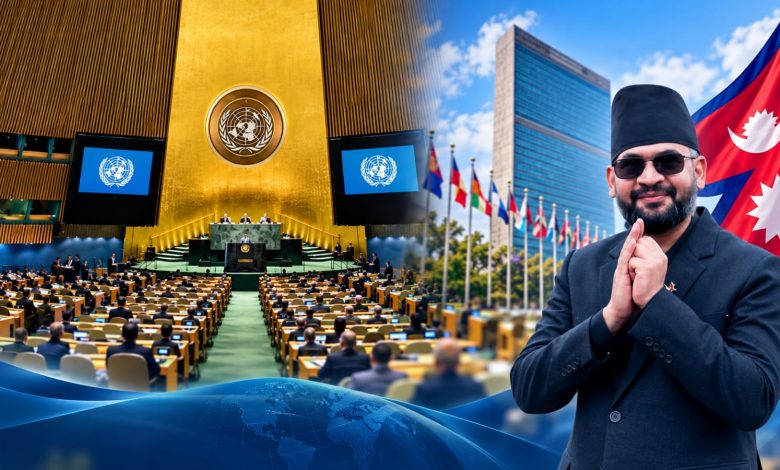
When Prime Minister Balendra Shah steps up to the podium of the United Nations General Assembly on September 24, the attention will not be limited to what Nepal has to say about climate change.
There will be a larger question surrounding the speech: what does the new leadership of Nepal want the world to know about the country and where it is headed?
It will also be Shah’s maiden foreign trip since taking office.
Shah arrives in New York at a significant moment for Nepal. The country has gone through a major political transition over the past year, a new government has taken office following elections, and the international community is watching how the new leadership defines its priorities.
Foreign Secretary Amrit Bahadur Rai has indicated that Nepal intends to use the General Assembly to present the Gen-Z movement, the subsequent election and the priorities of the new government to the international community.
So, when PM Shah speaks, the audience will be listening for more than a list of traditional foreign-policy positions.
They will be listening for a sense of what this new Nepal stands for.
And climate change is likely to be at the centre of that message.
Nepal’s climate argument has acquired a new height after the Bhote Koshi disaster.
The Foreign Ministry has said PM Shah will draw attention to the loss of life and property caused by climate-related disasters, while calling for climate justice, loss-and-damage support, climate finance and technology. Nepal also plans to highlight its forests, Himalayan ecosystems and river systems and its contribution to environmental protection.
But the government’s argument is increasingly about more than disaster relief.
It is about the country’s future.
For Nepal, climate change is becoming inseparable from questions of development, infrastructure, agriculture, livelihoods and economic security. The concern is that, repeated and increasingly severe climate impacts could consume resources that would otherwise be invested in development.
That gives the climate argument a sharper political edge:
If countries that have contributed relatively little to global emissions are facing some of the consequences first and most severely, what does the world order owe them?
That is where Nepal’s call for climate justice and accountability comes in.
The Bhote Koshi disaster has also given Nepal something more valuable than a general statement of vulnerability: a contemporary case through which to test the international climate architecture.
Manjeet Dhakal, who has worked for years at the intersection of climate science and international climate negotiations, argues that the recent disaster demonstrates the limits of adaptation.
He points to the destruction of an automated river-monitoring system during the event. The system was itself an adaptation measure until the scale of the disaster overwhelmed it.
That distinction is important.
Nepal can invest in early-warning systems, resilient infrastructures and adaptation.
But what happens when adaptation itself is no longer enough?
That is the space occupied by the international debate on loss and damage.
Dhakal says Nepal’s experience could provide an opportunity to test the Loss and Damage Fund’s rapid-disbursement mechanism and demonstrate whether an institution created to respond to climate-induced loss can respond when a real disaster occurs. He describes Nepal’s case as an opportunity to establish an example for the wider international community.
This is where Nepal’s diplomatic posture could become more consequential than simply asking for assistance.
It is seeking accountability from the international system for emissions reductions, climate finance and an effective response to loss and damage.
Dhakal also cautions against reducing that argument to a straightforward compensation claim against individual countries. The existing multilateral architecture separates emissions obligations from climate finance, and does not provide a simple mechanism for assigning the cost of a particular disaster to a particular emitter.
For Nepal, the more practical question is whether existing commitments can be translated into action.
This comes at another important point in Nepal’s development trajectory.
Nepal is scheduled to graduate from the UN’s Least Developed Country category in November 2026. That means the country is entering a new phase of international economic relations at precisely the time climate risks are becoming more consequential for its development.
The question is therefore not simply how Nepal will graduate.
It is whether the country can sustain development gains while dealing with climate shocks that increasingly demand resources for recovery and resilience.
That makes climate finance, technology and access to appropriate international support part of a much wider development argument.
The Prime Minister’s address is the most visible moment, but it is only one part of the diplomatic effort.
Foreign Minister Shishir Khanal, who is already in New York, is busy in participating in ministerial-level meetings involving the LDCs, landlocked developing countries, the Non-Aligned Movement and the G77 and China, as well as other high-level discussions, side events and bilateral meetings.
Nepal will also host “Sagarmatha to the Sea: A Call to Action for a Climate-Resilient Future” on September 25, giving the Himalayan dimension of climate change its own diplomatic platform.
Dhakal’s assessment is that these efforts need to work together: the General Assembly can provide the political signal and build solidarity among vulnerable countries, while the formal UN climate process must translate that signal into negotiations and action.
That is why the preparation of Shah’s statement matters.
The Foreign Ministry has led the process, working with relevant ministries and stakeholders to consolidate research, data and sectoral inputs. Prime Minister’s Press and Research Expert Dipa Dahal has indicated that the intention is to make Nepal’s voice substantive and evidence-based.
The emphasis suggests an attempt to move beyond the familiar language of vulnerability and put a more clearly evidenced proposition before the international community.
Climate change, however, will not be the entirety of PM Shah’s message.
The General Assembly will also be the new government’s opportunity to introduce itself to an international audience.
The world will see a Nepal emerging from political upheaval and elections, a new government defining its priorities, a country approaching LDC graduation, and a Himalayan state seeking to turn climate vulnerability into a larger diplomatic question.
The Prime Minister’s possible meeting with UN Secretary-General António Guterres will add another high-level channel to that engagement.
So, when PM Shah speaks on September 24, the question will not simply be what he can fit into 14 minutes.
It will be what kind of Nepal he chooses to put before the world and whether the country’s experience can be translated into a sustained international agenda.
For climate, that means moving from vulnerability to responsibility: from documenting what Nepal is losing to asking what the international system is prepared to do about it.
For the new government, it is an opportunity to establish its broader diplomatic posture.
And for the international audience, it will be an early indication of how Nepal’s new leadership intends to position the country in a world being reshaped by political transition, climate risk and an increasingly contested multilateral order.



Comments