
Nepal’s Political Elites Face Dissent Ahead of Convention Season
Sikshya Bhattarai
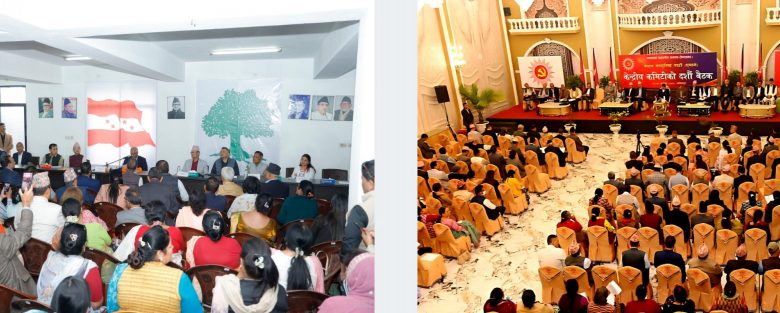
Nepal’s two largest political parties, CPN-UML and Nepali Congress, are grappling with rising internal dissent as calls for reform grow louder both within party structure. On Wednesday, CPN UML Chairperson KP Sharma Oli speaking at the inaugural session of the party’s 10th Central Committee meeting in Lalitpur emphasized the need for strong internal unity amid the country’s current political challenges.
Reiterating his party’s commitment to “principles, patriotism, development and social justice” the former Prime Minister urged all political forces to stand together for national interest. He also made a direct appeal to former UML leaders and cadres to return to the party and help consolidate its position ahead of the proposed General Convention proposed for December 13-15.
However, unlike other parties Oli has remained firm on the party throne and dismissed reports about his possible resignation, stating that only the party’s Central Committee holds the authority to decide on his leadership, not the Facebook posts.
The demand has further fueled debate within the party regarding leadership accountability, direction and election readiness and or preparation.
In a parallel development another major party, the Nepali Congress (NC) is facing mounting internal pressure as 2,488 delegates from the party’s 14th General Convention submitted a memorandum to acting President Purna Bahadur Khadka on demanding a special general convention. Congress president Sher Bhadur Deuba opting to relinquish the post has opened doors for reshuffle in the party leadership.
NC leader Gururaj Ghimire says the move follows the provision under Article 17(2) of the party statute, which mandates the organization of a special convention if at least 40% of delegates make such a request. The delegates represent around 54% of the total convention members.
The signatories say lack of preparation for a regular general convention especially with national elections coming up has led them to make this demand. The demand has further fueled debate within the party regarding leadership accountability, direction and election readiness and or preparation.
On the other hand, the recent decisions of the central committee of the CPN Maoist Centre also reflect on making a move towards generational renewal. Party Chairman Pushpa Kamal Dahal’s decision to step down as party coordinator from chairman after nearly four decades shows efforts towards responding to growing demands for reform.
These developments come at a time when Nepal is witnessing a surge in youth-led political activism, mainly driven by Gen Z citizens using social media platforms to challenge the old political order.
“Recent protests and social media campaigns have voiced frustration with corruption, lack of transparency and resistance to change from long-standing political elites. The movement that led to a change in government leadership, resulting in a new government leadership tasked with holding fresh parliamentary elections within a few months.”
CPN-UML’s dismissal of flooding ‘social media rumors’ and Nepali Congress’s procedural struggles may have emerged from a widening gap between traditional party leadership and the aware younger generation. As both parties head toward crucial decision-making moments, whether through UML’s planned General Convention , NC’s potential special convention or Maoist Centre’s declared readiness for fresh mandate, coming months will be pivotal in determining whether these organizations can reform from within or defy public trust.
Some members say that building trust and including the voices of the younger generation is essential for political parties to move forward and maintain their influence as they did in the past.
Comments