
Nepal Government Staffing Restructured
Sabika Shrestha/Keshav Raj Bista
The RSP government in its 100-day plan had announced swift and result oriented bureaucracy.
In line with the aim, the Organization and Management (O&M) Survey have been conducted at almost all government entities at war footing.
The aim is to identify the workforce based on the service delivery and the demand of the organization.
The National Personnel Records Office, which maintains updated records of all civil servants, said staffing registration process for 13 of the 15 ministries and their subordinate offices has been completed in the last five months.
The staffing details of two ministries were submitted only recently, and their registration process has begun.
The office said the entire process for 10 ministries has been completed and the details have already been sent back to the respective ministries.
According to Director and Information Officer Sudan Khwakhali Shrestha, the staffing structures of the Ministry of Finance, Ministry of Foreign Affairs, and Ministry of Agriculture are still pending.
An analysis of the 10 ministries whose staffing registration process has been completed shows that 500 positions have been cut from their previous staffing levels, while the analysis of the remaining ministries is yet to come.
Conducting an Organization and Management Survey from time to time is a normal part of administrative reform.
However, a comprehensive study should be carried out to eliminate unnecessary positions while adding positions where they are genuinely required.
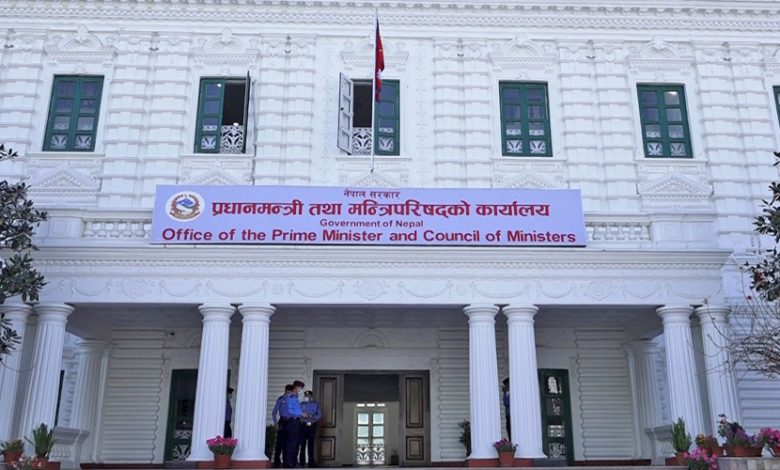
According to the staffing structures submitted so far, the Office of the Prime Minister and Council of Ministers had 952 positions previously, which has now been reduced by three to 949 positions.
The Ministry of Home Affairs has increased its staffing from 2,856 to 3,038, adding 182 positions.
The Ministry of Women, Children and Senior Citizens, Gender and Sexual Minorities and Social Security has increased its staffing from 151 to 174 positions, adding 23 posts.
The Ministry of Energy, Water Resources and Irrigation has seen the largest reduction, with 400 positions cut, bringing its staffing down from 1,226 to 826.
The Ministry of Culture, Tourism and Civil Aviation has reduced its staffing by 166 positions, from 724 to 558.
The Ministry of Education and Sports has cut 139 positions, reducing its staffing from 1,043 to 904.
The Ministry of Land Management, Cooperatives, Federal Affairs and General Administration has reduced its staffing by 135 positions, from 418 to 283.
The Ministry of Industry, Commerce and Supplies has cut 92 positions, bringing its staffing down from 789 to 697.
The Ministry of Information and Communications has reduced its staffing by 52 positions, from 233 to 181.
The Ministry of Youth, Labour and Employment has reduced its staffing by 25 positions, from 371 to 346.
The Ministry of Defence has cut 18 positions, reducing its staffing from 83 to 65.
The Ministry of Health and Food Safety has reduced its staffing by 13 positions, from 1,914 to 1,899.
The Ministry of Law, Justice and Parliamentary Affairs has reduced its staffing by 10 positions, from 124 to 114.
Meanwhile, the Ministry of Science, Technology and Innovation has created 90 new positions, according to the National Personnel Records Office.


Comments