
Constitution-Aligned Priority Bills
Sabika Shrestha
The government has begun introducing bills this year aimed at aligning laws with the spirit of the Constitution and the needs of a changing society.
Nearly a decade after the implementation of federalism, the government has, for the first time, initiated the process of amending mining legislation to clearly delineate the responsibilities of all three levels of government in the mining and mineral sector.
The bill, registered in the House of Representatives to amend the Mines and Minerals Act, proposes provisions defining the authority, responsibilities, and revenue-sharing mechanisms among the federal, provincial, and local governments.
It outlines separate powers for each level of government regarding the collection of royalties, fees, land lease charges, and service charges.
Under the proposed provisions, local governments will be responsible for mineral conservation, local monitoring, extraction of designated mineral resources, and collection of local mineral utilization fees.
Provincial governments will be granted authority over mineral exploration permits, management of exploration activities, recommendations, and coordination. The federal government, meanwhile, will retain responsibility for national policy formulation, strategic planning, declaration of mining zones, large-scale mining operations, and detailed geological studies and research.
This is the first such legislative initiative since Nepal adopted federalism, aimed at restructuring the mining and mineral sector in accordance with the federal governance system.
On July 29, seven bills, including the Mines and Minerals Amendment Bill, were registered in the House of Representatives. On the same day, two additional bills were registered in the National Assembly.
Declaring the current year as the “Year of Lawmaking,” the government had submitted a legislative plan to the Federal Parliament Secretariat proposing 166 bills. However, so far only 13 bills have been registered—11 in the House of Representatives and two in the National Assembly.
Besides the Mines and Minerals Amendment Bill, the House of Representatives has also received bills to amend laws relating to the remuneration, terms of service, and benefits of constitutional office bearers, the Employees Provident Fund, the Passport Act, the Human Trafficking and Transportation Control Act, the Child Labor Prohibition Act, and the Mediation Act.
Similarly, the National Assembly has registered bills concerning domestic air service liability management and the control of infectious animal diseases.
According to the Federal Parliament Secretariat, only four bills have so far been passed by the National Assembly. Meanwhile, the long-awaited Civil Service Bill, which the government has identified as one of its priorities, has yet to move forward.
Eakram Giri, Secretariat of Federal Parliament, said, “Parliament is not without business. Urgent public importance proposals, resolution motions, and ministry-wise question-and-answer sessions are continuing. While bills will move forward after completing their required maturity periods, other parliamentary business is ongoing and legislative work will certainly progress.”
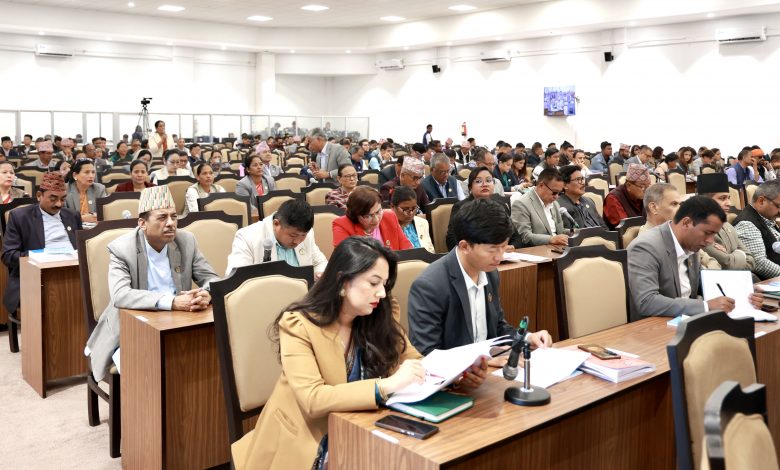
At present, various bills are under clause-by-clause discussion in the Education, International Relations and Tourism, Finance, and State Affairs and Good Governance Committees of Parliament.


Comments